
News events
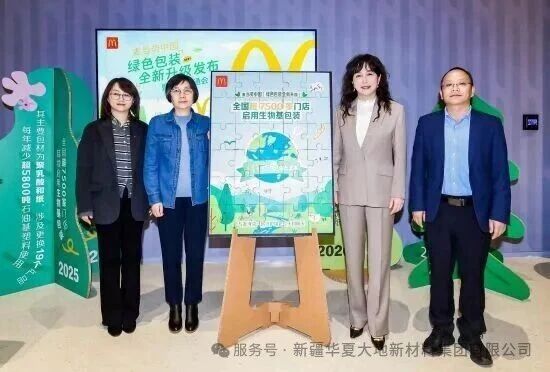
On December 19th, McDonald's China announced a further green upgrade of its meal packaging. Over 7,500 restaurants across the country will gradually adopt new bio-based packaging mainly made of polylactic acid (PLA). This is not only another significant move by McDonald's China on the path of environmental protection, but also marks the arrival of the era of large-scale application of PLA. It is estimated that this upgrade will reduce the use of petroleum-based plastics by over 5,800 tons annually. Gu Lei, Chief Impact Officer of McDonald's China, said that McDonald's China's large-scale application of bio-based packaging further promotes the transformation of customer packaging materials to renewable resources, and this innovation fills the gap in this area globally for McDonald's.
News in Depth
Analysis of Key News in the Chemical Industry
McDonald's environmental protection practices
This upgrade by McDonald's is far from a simple replacement of materials. It has gone through a rigorous research and development screening process. McDonald's China worked together with supply chain partners to tackle the challenge, evaluating approximately 100 packaging options. After over 2 million practical tests, they finally achieved the innovative large-scale application of biodegradable packaging. Regarding consumer experience, the new packaging has been specially optimized. The new cold drink cup lid adopts a "double-arched anti-leak" structure, which has obtained a patent for the design; the hot drink cup lid uses a self-developed formula to enhance the toughness and heat resistance of the PLA material. This has solved the long-standing "experience problem" of environmentally friendly packaging.
Weng Yunxuan, the executive dean of the College of Light Industry Science and Engineering at Beijing University of Technology, commented: "McDonald's' large-scale application of PLA biobased materials in China represents a forward-thinking exploration of green packaging. It is of great significance for the development of the biobased materials industry and the sustainable development of the catering industry."
Dual drive by policies and markets
McDonald's action is not an isolated incident; rather, it occurs against the backdrop of the accelerated global push for carbon neutrality and the vigorous development of the bioeconomy. The EU's "Single-Use Plastics Directive" requires that all plastic packaging be recyclable or degradable by 2030, directly driving the demand for PLA; under China's "carbon neutrality" goals, bio-based materials have been included in the "First Batch of Demonstration Catalogue for Key New Materials for Initial Application". These policies provide solid institutional support for the polylactic acid industry.
Market data also confirm the high growth trend of the industry. According to data from Zhiran Research, the market size of biodegradable materials in China reached 29.9 billion yuan in 2024, with a year-on-year growth of 29.59%. It is expected that the industry scale will exceed 48 billion yuan in 2025. Among them, PLA, as the mainstream category, has achieved large-scale application and will continue to hold a dominant position in the market in the medium and long term. From 2020 to 2024, China's PLA production capacity increased from 89,000 tons to 309,000 tons, with an average annual compound growth rate of 36.7%. It is expected that the production capacity will further rise to 365,000 tons in 2025.
Competitive landscape and industrial chain ecosystem
The industrial application of polylactic acid was discovered earlier abroad, with the technologies in the United States and the Netherlands being the most advanced. The American company NatureWorks has two 70,000-ton production lines and one 10,000-ton production line specifically for producing HP (high gloss pure) specifications. The total annual production capacity is 150,000 tons. Later, it announced a capacity expansion of 10% to remove bottlenecks and is currently building a 75,000-ton plant in Thailand. The Dutch company Corbion-Purac has a 30-year history of producing medical polylactic acid and is the world's largest supplier of lactic acid (accounting for 50% to 60% of the global lactic acid market share). Corbion jointly established the Total Corbion Polylactic Acid Company with the French company Total to operate the PLA business, with an annual production capacity of 75,000 tons.
Domestic enterprises are breaking through technological barriers and strengthening their autonomy in the industrial chain. Anhui Fengyuan has built a 400,000-ton/year polylactic acid production facility, and currently the production capacity after startup is 1 million tons/year. It also has supporting facilities for raw material pretreatment, thermal power generation, and environmental protection, forming a full industrial chain advantage. The Jindan Technology's annual 75,000-ton polylactic acid project is under construction.
Expanding the diversity of application scenarios
The traditional application fields of PLA have mainly focused on food and beverage as well as feed additives. However, this situation is changing. With the escalation of global "plastic restriction policies" and the explosive demand for bio-based materials, polylactic acid has become the core driving force for industry growth.
In the packaging field, PLA can replace polyethylene (PE) to produce degradable straws, tableware and plastic films, thus solving the problem of white pollution. The case of McDonald's further proves that PLA has the ability to scale up and replace traditional petroleum-based plastics in the food packaging sector. In the 3D printing field, PLA has become the mainstream consumable due to its low shrinkage rate and high precision characteristics. In the medical field, PLA-based materials are used to manufacture orthopedic fixation supports and surgical sutures, and their biodegradability can avoid the risk of secondary surgeries. Poly(lactic acid) hydroxyacetic acid copolymer (PLGA) and other special types of PLA materials can meet different medical scenarios by flexibly adjusting the degradation rate. In the future, the application scenarios of PLA will continue to expand to high-value-added fields. The PLA engineering plastics that have improved performance through composite modification will be more widely used in automotive interiors, electronic and electrical components and other scenarios with strict material requirements. The diversification of application scenarios will further enhance the added value of the PLA industry.
Future Trends
The case of McDonald's in China demonstrates that the PLA industry is moving from the "small and scattered" demonstration stage to the "large and powerful" scale-up stage. With technological breakthroughs and cost reductions, PLA will replace traditional plastics in more fields. For industry enterprises, only by closely following policy directions, focusing on technological innovation, and optimizing the industrial chain layout can they seize the initiative in the green transformation wave. In the coming years, the PLA industry will enter a "golden development period", and those enterprises that have made early preparations in terms of technology, cost, and market will be expected to become the biggest winners of this transformation.