
Have you ever wondered where all the takeout boxes and delivery bags you throw away every day end up?
The answer is: Most of them are buried in the soil and won't decompose even after 200 years.
But this situation is about to change. A new material that can "disappear" on its own is quietly replacing the plastic bags in your hands. Moreover, the scale of this market might be much larger than you could have imagined.
A shocking number: 36 times
Let's take a look at a set of data:
After the policy is fully implemented, in just the three sectors of food delivery, express delivery and agricultural film, the demand for degradable plastics will reach 15.4 million tons, corresponding to a market value of approximately 27 billion yuan.
At present, the actual usage in China is only 42,000 tons.
42,000 tons → 1,540,000 tons, an increase of 36 times.
This is not a publicity stunt. It is the inevitable outcome driven by policies. More than 100 countries and regions around the world have already implemented plastic restriction or ban measures. The enforcement intensity in China in 2026 will only be greater.
The next time you order takeout, you might have noticed - some restaurants have switched to those plastic containers that feel a bit different and claim to be "biodegradable". Yes, this change is indeed taking place.
PLA and PBAT: Two Names You May Not Have Heard Of
Don't be intimidated by these two English names. In fact, they are quite easy to understand:
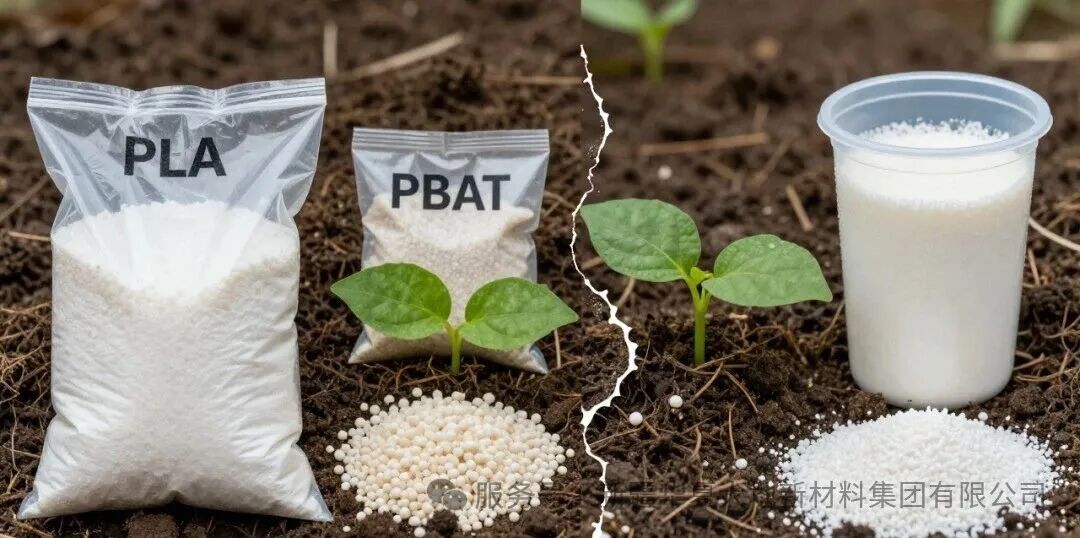
PLA (Polylactic Acid) - A plastic made from corn starch
Does it sound like something from the future? Actually, it's extracting the starch from plants like corn and sugar cane and turning it into plastic. The most crucial point is: when thrown into the soil, it can completely degrade within a few months, turning into water and carbon dioxide, with zero pollution.
Currently, the PLA accounts for 40% of the global production capacity of biobased degradable plastics. It is projected to rise to 67% by 2027, securing its position as a "dominant" player in this field.
PBAT (Polybutylene Adipate/Terephthalate Butylene) - A "soft plastic" that can be bent without breaking and can be stretched very long.
PLA is environmentally friendly, but it has a drawback: it is too brittle. It's fine for making cups, but it tears easily when used as a plastic bag. PBAT was developed to address this issue - it is soft, elastic, easy to process, and is currently the most widely used biodegradable plastic.
China's PBAT production capacity has quadrupled in just three years:
• 2021: 340,000 tons
• 2022: 640,000 tons
• 2023: 1,370,000 tons (an increase of 114% compared to the previous year)
China has transformed from a importer of PBAT to the world's largest producer and exporter.
Prices are dropping: getting cheaper and cheaper.
You might think that environmentally friendly products must be expensive. That was the case a few years ago. But now -
• PLA price: approximately 19,000 yuan per ton, down by over 20% compared to two years ago
• PBAT price: approximately 11,000 yuan per ton, down by nearly 40% compared to two years ago
• Ordinary plastic (PE): approximately 8,000 yuan per ton
The price of PBAT has dropped to 1.4 times that of traditional plastics. If it drops a little more, consumers won't even notice the difference.
And don't forget, the policy is mandatory. In many cases, you have no choice - if you don't use biodegradable materials, you won't be allowed to sell.
Who is making money? Take a look at these leading companies.
Jinfa Technology - The "Moutai" of the PBAT sector
Market share: 25%. Production in 2023: 375,000 tons. This position is comparable to Moutai in the liquor industry and Apple in the mobile phone sector.
Tongcheng Materials - Firmly Holding the Second Position
Market share: 15%. Output: 225,000 tons. Together with Jinfa Technology, the two companies account for nearly half of the market.
Jindan Technology, Anhui Fengyuan - The Main Forces in the PLA Field
The PLA production capacity has exceeded 100,000 tons per year and is currently undergoing rapid expansion.
If you want to invest, these are the names you can't ignore.
Changes in daily life: Have you noticed?
Ordering takeout: More and more merchants have switched to biodegradable food containers. Although it costs a few cents more, there's no guilt when throwing them away.
Receiving packages: Some e-commerce platforms have begun piloting biodegradable packaging for parcels. They can be used immediately after being torn open, and can simply be buried in the soil after use.
Shopping at the supermarket: Biodegradable shopping bags have appeared at the checkout counter. They feel a little thicker than ordinary plastic bags, but the texture is similar.
Using plastic film: Farmers in Xinjiang, Shandong and Gansu provinces may have already adopted fully biodegradable plastic film. The benefits are: crop yields increase by 5% to 10%, and the amount of residual plastic in the soil is reduced by over 80%.
In 2026, fully biodegradable plastic films were included in the agenda of the two conferences, and the promotion efforts will be further intensified.
Three notable signals
Signal One: Policies will only become stricter
China's plastic restriction policy is gradually being strengthened. By 2026, more cities and scenarios will be included in the plastic ban scope. This is not a temporary measure but a long-term trend.
Signal Two: Prices Will Continue to Fall
With the concentrated release of production capacity and technological advancements, there is still room for the prices of PLA and PBAT to decline. When the prices drop to within 1.2 times that of traditional plastics, the market will experience explosive growth.
Signal 3: The application scope is expanding.
Not only are disposable boxes and shopping bags involved. Textile fibers, medical devices, 3D printing materials... Biodegradable materials are entering an increasing number of fields.
Final Note
Every time you throw away a plastic bag, a small piece of garbage that won't disappear for 200 years is added to some corner of the earth.
But the good news is that this situation is changing. New materials like PLA and PBAT are replacing "plastic made from petroleum" with "plastic grown from plants".
A 36-fold growth potential - it's not just a dream, but a trend.