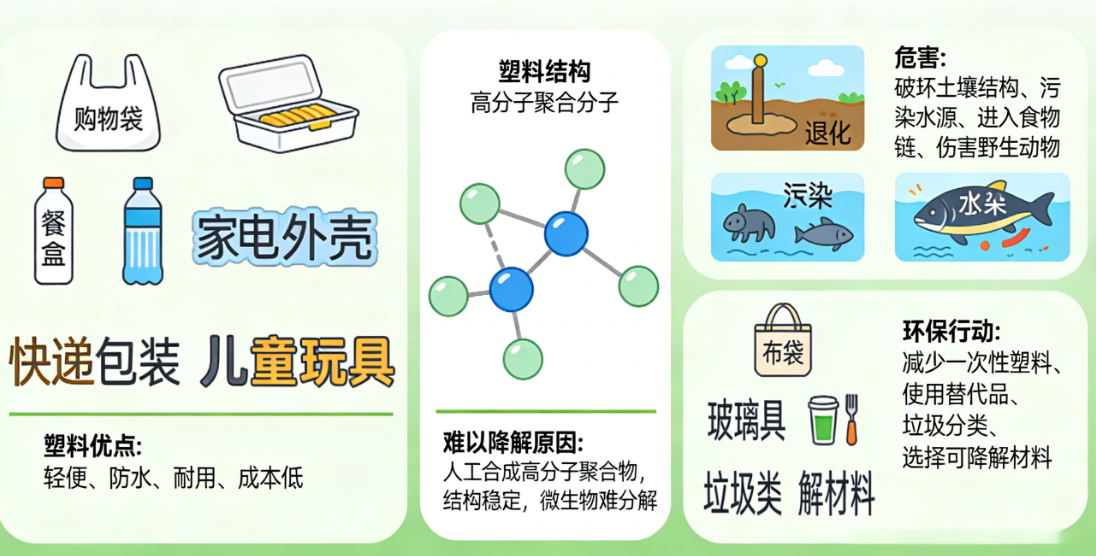

The straws in milk tea cups, the takeout boxes, and the shopping bags in supermarkets - nowadays, you can always see the words "degradable" on them. They carry the label of environmental protection and quietly integrate into our daily lives.
When hearing about degradable plastics, we always have some questions. Where do they come from? How are they disposed of? And how should we properly deal with them? Let's jointly understand the truth about this environmentally friendly material and practice true environmental protection actions.
I. What is degradable plastic?
Biodegradable plastics refer to plastics that, under specific conditions such as in nature, in composting, or through anaerobic digestion, are eventually completely degraded into carbon dioxide or methane, water, mineral inorganic salts, and biomass by the action of microorganisms.
In simple terms, it needs to be exposed to the right environment where it will be "eaten" by bacteria and fungi, eventually turning into harmless substances without any microplastic residue left behind.
II. Four Types of Biodegradable Plastics: Where Do They Come From? And Where Are They Used?
PLA (polylactic acid) is currently the most widely produced and widely used degradable plastic in the world - "the hard shell made from corn"
Raw material source: Produced by fermenting the starch from corn, cassava or straw (biological-based).
Characteristics: Transparent, high in hardness. It can only be rapidly decomposed in industrial composting (at temperatures above 50°C) and is very stubborn at room temperature.
Main applications: Fast food containers, straws, 3D printing materials.
2. PBAT is a reliable biodegradable material that decomposes completely without leaving any residue - "the softest version that resembles ordinary plastic bags"
Source of raw materials: Petrochemical synthesis (fossil-based).
Characteristics: Extremely flexible, resistant to tearing and water, the texture is very similar to the traditional plastic bags we usually use.
Main applications: supermarket shopping bags, express delivery bags, cling film.
3. PHA (Polyhydroxyalkanoates) is the most promising safe material that can fully replace traditional plastics - "a versatile microbial product"
Source of raw materials: Bio-based materials synthesized through microbial (such as bacterial) fermentation.
Characteristics: Extremely biocompatible, it can be directly degraded in seawater, freshwater and soil.
Main applications: High-end packaging, medical sutures, marine environmental protection products.
4. PBS (Polybutylene Succinate) - "The Heat-Tolerant Prodigy"
Source of raw materials: Both biological fermentation and petroleum routes are acceptable.
Characteristics: Resistant to high temperatures, maintaining stability above 100℃. It can be decomposed through composting as well as in the soil.
Main applications: One-time heat-resistant tableware, agricultural films.
III. It is essential to be vigilant: Biodegradable plastics are not "able to decompose anywhere"
1. PLA/PBAT cannot do without "high-temperature factories"
Only under the conditions of industrial composting (high temperature, high humidity, and high microbial density) can they disappear within 1 to 6 months.
If PLA is thrown into normal temperature soil, the ocean or a household trash bin, its degradation rate is almost as slow as that of ordinary plastics, and it may take several years or even longer.
2. Throwing them around will instead result in "microplastics".
Those materials labeled as "photo-degradable" will only break down into smaller microplastics if they are buried in the soil before the reaction is complete under light exposure, thus causing secondary pollution.
Expert conclusion: Only biodegradable plastic made from biological sources is a truly environmentally friendly solution; random disposal still causes pollution.
Four. How to make a reliable purchase? Trust this label
In 2021, the country implemented the unified standard GB/T41010-2021. Please make sure to recognize it.
Material identification: It must clearly state whether it is PLA, PBAT or PHA, etc.
Degradation environment: It must be clearly stated whether it is "industrial composting" or "soil degradation".
Unified Logo: The green double "j" circular logo (degradable initial letter).
V. This Environmental Performance Report (Data Speaks)
Carbon reduction effect: Compared with traditional PE plastic bags, PLA plastic bags reduce carbon emissions by 70%. Over the past five years since the implementation of national standards, it is estimated that 20 billion traditional plastic bags will be saved each year, saving 1.2 million tons of oil and reducing carbon emissions by 840,000 tons.
VI. Closing Remarks
Biodegradable plastics are a gentle gift from technology to nature, but they are never an excuse for wastefulness.
It carries the expectations of reducing plastic use and carbon emissions. Only by correctly classifying and properly disposing of it can this material return to the dust and benefit nature, truly completing the environmental protection closed loop from "creation" to "degradation". We hope that everyone can recognize the value of each type of environmental protection material, not blindly or rashly, and carefully protect the green mountains and clear waters, so that every environmental protection choice can truly nourish this land that we deeply love.
Reference source:
1.Science China. "Interpretation of the Classification and Labeling Guidelines for Biodegradable Plastic Products"
2. People's Daily Online. "The 'Plastic Restriction Order' Has Created Massive Profits for the Industry. Experts Explain What 'Biodegradable' Means"
3. CCTV News. "Biodegradable plastics ≠ 'Disposable' ≠ Can Be Thrown About Haphazardly! The Science Myth List Reveals the Truth About Pollution"
4. CCTV website. Related reports on the "New National Standard for Biodegradable Plastic Bags"