

From the perspective of material structure, the clinical application of PLA in dermatology
In recent years, the use of polylactic acid-based fillers in medical aesthetic dermatology has been increasing.
Many people seeking beauty tend to simply understand it as a "filler" and even directly compare it with hyaluronic acid. However, from the perspective of material mechanism, polylactic acid does not merely rely on the material itself to occupy space for shaping. Instead, it forms a stimulus in the tissue through degradable microparticles, inducing fibroblast activation, and thereby promoting collagen regeneration and tissue remodeling.
It is precisely for this reason that the clinical value of polylactic acid products lies not only in "filling up what is lacking", but also in the comprehensive improvement of skin texture, tissue volume, contour support and long-term collagen regeneration.
I. What is PLA?
PLA, or polylactic acid, is a type of biodegradable material.
In medical aesthetic dermatology, the common polylactic acid materials mainly include two types:
The first type is PLLA, poly-L-lactic acid. It has a relatively high crystallinity, a slower degradation rate, and usually lasts longer. Clinically, it is often used in scenarios where long-lasting collagen stimulation and tissue support are needed.
The second type is PDLLA, poly-DL-lactic acid. It has a relatively amorphous structure and degrades faster, and is typically used for relatively mild and gradual collagen stimulation.
In simple terms, PLA-type products are not materials that "set immediately" after injection, but rather materials that gradually take effect within the tissue through the action of their particles.
The basic process is roughly as follows:
After injection into the dermis or subcutaneous layer, the microparticles disperse within the tissue and subsequently induce the activation of local fibroblasts, initiating collagen neogenesis and extracellular matrix remodeling. As the material gradually degrades, the newly formed collagen by the tissue itself becomes an important basis for maintaining the effect in the subsequent period.
Therefore, the core logic of polylactic acid-based fillers is not "how much is filled in", but "whether stable and controllable tissue reactions can be induced at the appropriate level, with the appropriate dosage and in the appropriate structure".
Second, the differences among polylactic acid (PLA) products lie in their structures. From a clinical application perspective, when it comes to PLA fillers, it is not enough to merely consider whether they are made of polylactic acid; the material structure is also crucial.
Different structures can affect the dispersibility of materials, degradation rate, tissue stimulation intensity, nodule risk and clinical adaptation sites.
The common structures currently can be roughly classified into the following categories:
Smooth solid microsphere structure
This is a type of structure that is currently more common and better meets the mainstream clinical needs.
The surface of smooth microspheres is relatively regular, with more uniform particle size and better dispersion within the tissue. Their advantages lie in relatively stable stimulation, more controllable inflammatory response, and lower risk of nodules.
For clinicians, the smooth solid microsphere structure is more suitable for scenarios such as facial volume improvement, skin quality enhancement, and mild contour support.
2. Porous microsphere structure
The characteristic of porous microspheres is that they have a porous internal structure, which increases the contact area between the material and the tissue and enhances the ability to stimulate collagen.
However, strong stimulation does not necessarily mean greater safety. The porous structure may cause more obvious tissue reactions, thus requiring higher standards for injection depth, dosage control, and indication screening.
3. Lamellar or irregular structure
This type of structure has an irregular surface, making the tissue reaction more difficult to predict completely. After local accumulation, it may increase the risk of nodules, indurations, etc.
Therefore, from the perspective of the development trend of modern injection materials, the clinical practice is more inclined to choose microsphere structures with uniform particle size, regular surface and more controllable tissue reactions.
III. Particle Size Determines Application Levels
The particle size of PLA fillers is not a simple parameter; it directly affects the injection level and the selection of indications.
Generally speaking, the smaller the particle size, the more suitable it is for shallow layer applications; the larger the particle size, the more it is inclined to be used for deep layer support.
25–40 μm: Shallow layer application
This particle size range is more suitable for improving the quality of the superficial skin.
Clinically, it can be used to improve fine lines, rough skin texture, prominent pores, and decreased skin luster. Its focus is not on providing strong support but on gradually improving skin texture through stimulation of superficial collagen.
40–63 μm: Mainstream filling application
This range falls within the more common clinical application particle size and is suitable for use in the deep dermis or superficial subcutaneous layer.
For instance, issues such as nasolabial folds, marionette lines, mild to moderate facial depressions, volume loss, and poor contour transitions may all involve applications at this level.
It takes into account both a certain degree of volume improvement and collagen stimulation, and is within the more mainstream clinical application range.
63–100 μm: For deep layer support applications
Materials with larger particle sizes are usually more suitable for supporting needs in the deep subcutaneous layer or near the periosteum.
For instance, problems such as insufficient deep facial volume, reduced bony support, and unclear contour structure may require more profound tissue remodeling and support.
However, such applications place higher demands on doctors' understanding of anatomy, injection layers, and dosage judgment. It cannot be simply understood as "the larger the particles, the better the effect."
The clinical value of PLA is not limited to anti-aging filling.
The application of polylactic acid-based materials in dermatology is extending from traditional filling to more comprehensive skin regeneration treatment.
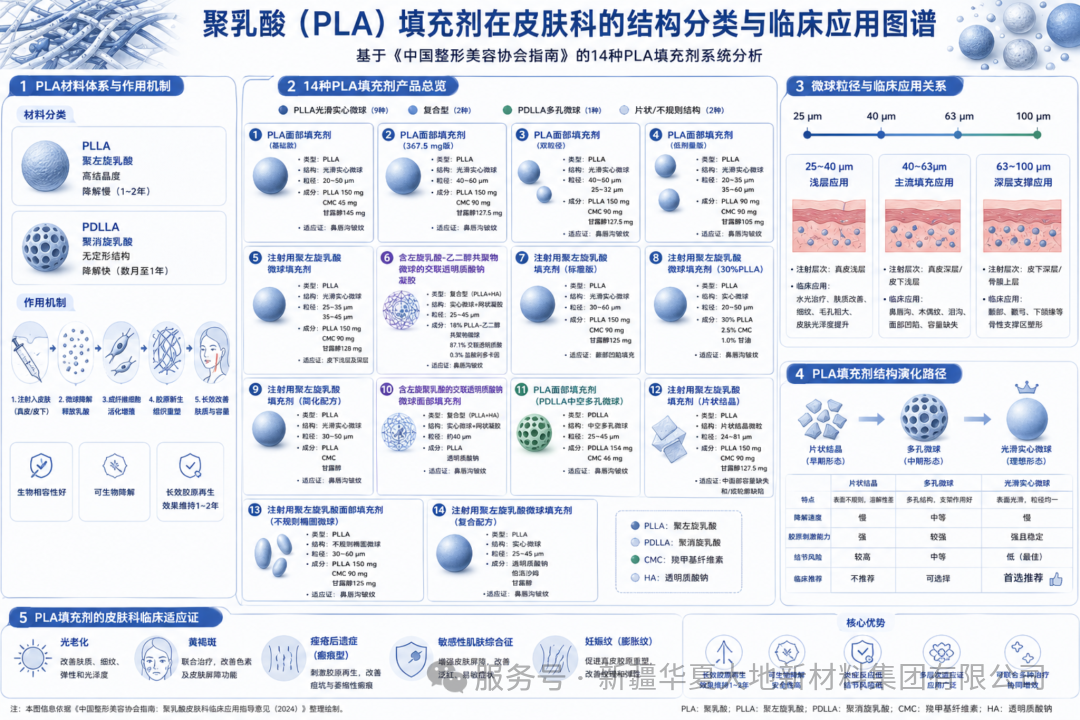
The current common clinical directions include:
1.Facial photoaging
For signs of photoaging such as loose skin, fine lines, reduced elasticity, and decreased luster, PLA can improve skin texture by stimulating collagen production, enhancing skin firmness and fullness.
It is not a one-time, immediate-impact treatment. It is more suitable for those who wish to achieve gradual and natural improvements.
2. Loss of facial volume
As one ages, the facial fat pads, ligament support, bony structure and skin collagen all undergo changes.
When used at the appropriate level, PLA can be employed to alleviate moderate to severe volume loss, thereby smoothing and naturalizing the facial contours.
3. Atrophic scar after acne
For some depressed acne scars, PLA can be used as one of the combined treatment options. By stimulating the remodeling of dermal collagen, it can improve local depression and skin texture.
However, acne scars are of diverse types and usually require a combined approach using methods such as fractional laser treatment, microneedling, dermabrasion, and fillers, rather than relying solely on a single material.
4. Supplementary treatments for pigment and barrier-related issues
Some of the materials also mention that PLA can be used in combined treatments to improve the skin barrier function, inflammatory state and skin quality related to melasma.
However, it is important to note that melasma is a complex condition, and the core of treatment should still focus on comprehensive strategies such as sun protection, anti-inflammatory measures, barrier repair, and regulation of pigment metabolism. PLA is more suitable as an auxiliary tool to improve skin texture and barrier function, rather than as a substitute for standard treatment.
5. Sensitive Skin and Skin Barrier Issues
In some indications, PLA can improve skin stability by promoting collagen and extracellular matrix remodeling.
However, sensitive skin itself has multiple factors such as inflammation, damaged barrier, and vascular reactions. Before treatment, it is necessary to determine whether it is in an acute unstable phase. If there are obvious redness, stinging, or inflammatory reactions, the basic skin condition should be controlled first, and then regenerative treatments can be considered.
6. Changes in the dermal structure such as stretch marks and fat streaks
Stretch marks and obesity marks are essentially related to damage to the dermal collagen and elastic fibers.
The collagen-stimulating effect of PLA makes it possible for it to be involved in this type of dermal remodeling treatment. However, such issues usually have a long treatment period and the expectations should be reasonable. The main goal is to improve texture, elasticity and skin quality rather than completely eliminating them.
V. What do doctors need to pay more attention to?
For doctors, the key point of using PLA-type fillers is not merely "choosing which product to use", but establishing a comprehensive clinical judgment.
At least the following issues should be paid attention to:
First, the stability of the material structure.
Whether the surface is regular, whether the particle size is uniform, and how the dispersion is after re-dissolution, all these factors will affect the subsequent organizational reaction.
Second, does the indication match?
For superficial skin texture improvement, stimulation of dermal collagen, and deep volume support, the required product structure and injection strategy are not the same.
Third, is the layering accurate?
PLA (polylactic acid) materials are not better when they are lighter in color; nor are they safer when they are darker. Different particle sizes and different indications require completely different layering requirements.
Fourth, is the dosage appropriate?
Regenerative materials are most sensitive to excessive stimulation. Collagen regeneration requires time. Excessive injections or frequent repetitions over a short period may increase uncontrollable risks.
Fifth, is the postoperative management standardized?
The nodules, hard lumps, and local unevenness after poly(lactic acid) treatment are often related to re-dissolution, injection, massage, layering, dosage, and individual responses. Doctors need to clearly communicate before the treatment and carry out follow-up management.
VI. Objective Advice for Those Seeking Beauty
Polylactic acid is not a "miracle product for maintaining youthful appearance" nor is it a universal anti-aging material.
Its advantages lie in its biodegradability, ability to stimulate collagen regeneration, and relatively gradual and natural effect. It is suitable for skin quality decline, mild to moderate volume loss, poor contour integration, and partial dermal remodeling needs.
But it is also not suitable for everyone.
If the expectation is for immediate and significant improvement, other materials might be more suitable; if there is already active inflammation, unstable skin condition, a risk of scarring, or if the expectations for treatment are unrealistic, a careful assessment is necessary.
The most important aspect of medical aesthetic treatment is not to pursue a new concept, but to comprehensively consider the materials, layers, dosages, indications and the doctor's experience.
The truly safe and effective treatment is not to inject popular materials into the face, but to use the appropriate materials on the right person, through the right method, to achieve controllable results.
Conclusion
The value of PLA (polylactic acid) fillers is shifting from simply "filling" to "renewal".
It represents the transformation of medical aesthetic materials from immediate space occupation to tissue remodeling.
However, the more it is a regenerative material, the more it requires doctors to have a clear understanding of the material and a sense of clinical boundaries.
For doctors, understanding the material structure, particle size differences, action levels and risk control of PLA is more important than merely memorizing the name of a certain product.
For those who pursue beauty, there is no need to be carried along by words like "collagen renewal", "youthful appearance", or "anti-aging".
Cosmetic medicine is not magic.
The materials have logic, the treatment has boundaries, and the effects take time to manifest.
What truly deserves to be chosen is not the more sophisticated materials, but the medical plan that better suits one's own situation.