
China's annual plastic film usage amounts to approximately 1.38 million tons, with a total farmland mulching area of about 300 million mu. As a crucial production input for stable and increased yields in dryland agriculture, fruit and vegetable cultivation, cotton farming, and other crops, the massive scale of application has driven continuous iteration and upgrading of plastic film management policies.
On June 2, the State Council issued the "15th Five-Year Plan for Accelerating the Modernization of Agriculture and Rural Areas." Compared with the "14th Five-Year Plan for Advancing the Modernization of Agriculture and Rural Areas," the state has shown a clear shift in top-level policy statements and implementation strategies regarding plastic film management. Coupled with the continuous expansion of demonstration and promotion efforts and the initiation of revisions to national standards for biodegradable mulch films, China's plastic film governance has entered a new phase of comprehensive, science-based chain management.
1. Shifting from "R&D and Promotion" to "End-to-End Closed-Loop Governance"
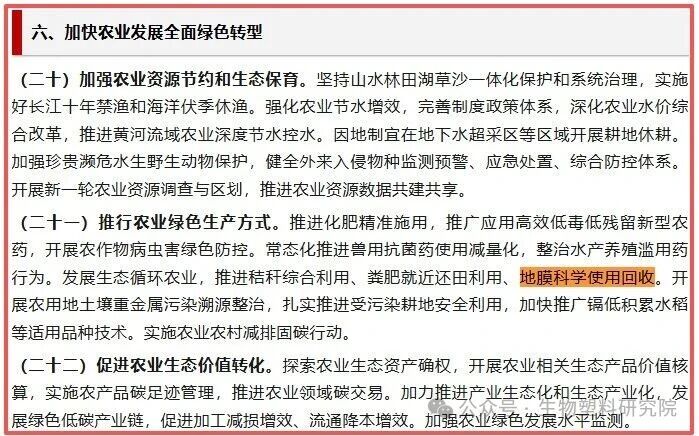
The 14th Five-Year Plan proposes in the section on pollution prevention and control from agricultural non-point sources: accelerate the widespread use of standardized plastic film, strengthen research and promotion of biodegradable agricultural films, and advance mechanized collection and professional recycling of used agricultural films. The statement emphasizes two ends: at the front end, promoting standardized film usage and implementing biodegradable film R&D; at the back end, focusing on the recovery of waste film. Overall, the approach involves initial pilot research and development, followed by phased implementation and expansion.
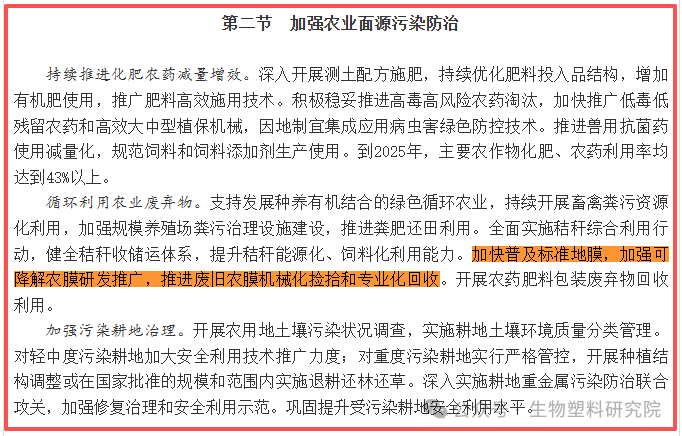 The "15-15" plan has optimized the section on green agricultural production as follows: Promote the scientific use and recycling of plastic films. These ten words encompass comprehensive upgrades. Previously, it was "standard films + degradable films + separate promotion for recycling", which has now been upgraded to an integrated planning approach covering source selection, field application, and plastic film recycling. It integrates thick-walled weather-resistant films and fully biodegradable films into the scientific application system, reflecting a shift in governance thinking from individual pilot projects to systematic closed-loop governance.
2. The scale of the promotion of the two types of plastic films has expanded significantly year after year.
The implementation of policy guidance can be directly observed from the data of the project on the scientific use and recycling of plastic films. At the beginning of the project in 2022, the annual task for thick and high-strength plastic films was 50 million hectares, and for fully biodegradable plastic films it was 5 million hectares. By 2025, these two indicators will increase to 96.94 million hectares and 11.53 million hectares respectively, totaling 108.47 million hectares, accounting for 36% of the total plastic film coverage area of 300 million hectares in the country.
In just a few years, the application areas of thickened high-strength plastic films and biodegradable films have significantly expanded, continuously squeezing out the market space for ultra-thin non-standard films. The structure of China's plastic film products has been continuously optimized.
3. National standards are being revised simultaneously, filling the gaps in industrial supervision.
As industrial scale expansion accelerates, the supporting standard system is also simultaneously filling in the gaps in its deficiencies.
The current GB/T 35795-2017 "Biodegradable Agricultural Ground Cover Film" was implemented in 2018 and has long supported the industrialization development of biodegradable plastic films. However, the current standard also has shortcomings: the connection and applicability of the degradation performance regulations with international standards need to be strengthened, the types of materials for biodegradable plastic films need to be updated and improved, and it is necessary to establish a traceability system to combat counterfeit biodegradable products, etc.
In February 2025, the revision plan for the national standard was officially approved and initiated. It was coordinated by the National Committee for Biobased Materials and Degradable Products and led by Beijing University of Commerce for the compilation.
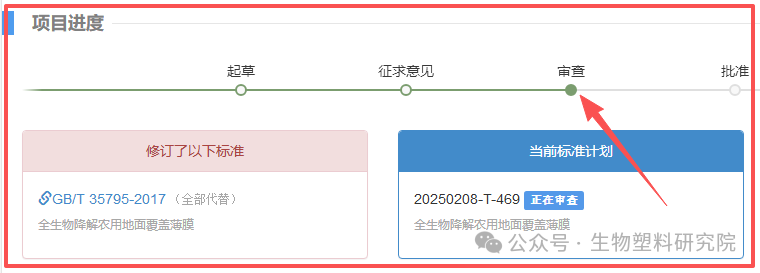
The new version of the standard is planned to add key provisions such as ultra-long growth period degradable plastic film products, 180-day temperature-neutral soil degradable and ecological toxicity testing, and infrared spectroscopy screening of petroleum-based plastics. These measures will strengthen the technical barriers for product entry, providing a solid foundation for the standardized and large-scale promotion of degradable plastic films during the 15th-17th Five-Year Plan period.
From adjustments in planning wording, to the increase in actual land area, and then to the iterative improvement of industry standards, the multi-dimensional policy efforts have worked together to shift the domestic plastic film industry from pollution-end-of-pipe treatment to green and standardized full life-cycle management, facilitating the steady progress of the green modernization of agriculture and rural areas.