
Driven by both the “dual-carbon” goals (carbon peak and carbon neutrality) and the technological revolution, biomanufacturing is transitioning from laboratories to the core of industrial development. It has become a key future industry prioritized in China’s 15th Five-Year Plan (2026–2030) and serves as a pivotal engine for reshaping the global manufacturing landscape and cultivating new quality productive forces. Leveraging renewable biomass as feedstock and harnessing cutting-edge technologies such as synthetic biology and gene editing, biomanufacturing replaces conventional chemical production with “cell factories.” This approach offers three major advantages: environmental sustainability and low carbon emissions, renewable raw materials, and high value-added outputs—spanning trillion-yuan-scale sectors including advanced materials, clean energy, pharmaceuticals, and agriculture.
I. Biomanufacturing: Redefining "Green Production"
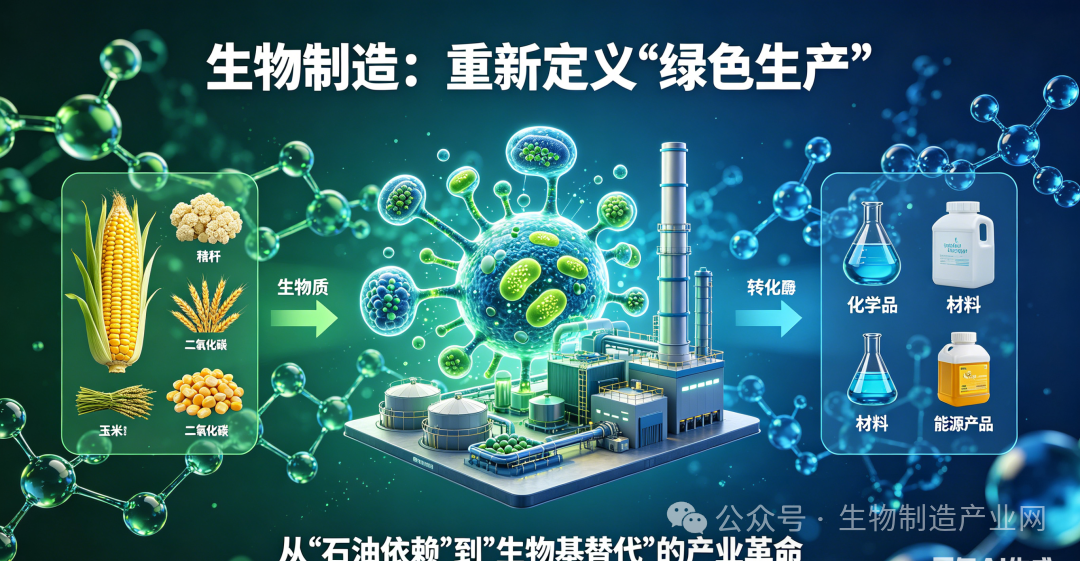
Biomanufacturing is a sustainable manufacturing model that uses microorganisms, enzymes or cells and other biological entities as "factories" to convert biomass (such as corn, straw, carbon dioxide, etc.) into chemicals, materials and energy. Its core is to replace chemical processes with biological ones, achieving an industrial revolution from "oil dependence" to "biobased alternatives".
II. Full Industrial Chain Dissection: Synergy among Upstream, Midstream and Downstream, with Clear Value Gradient
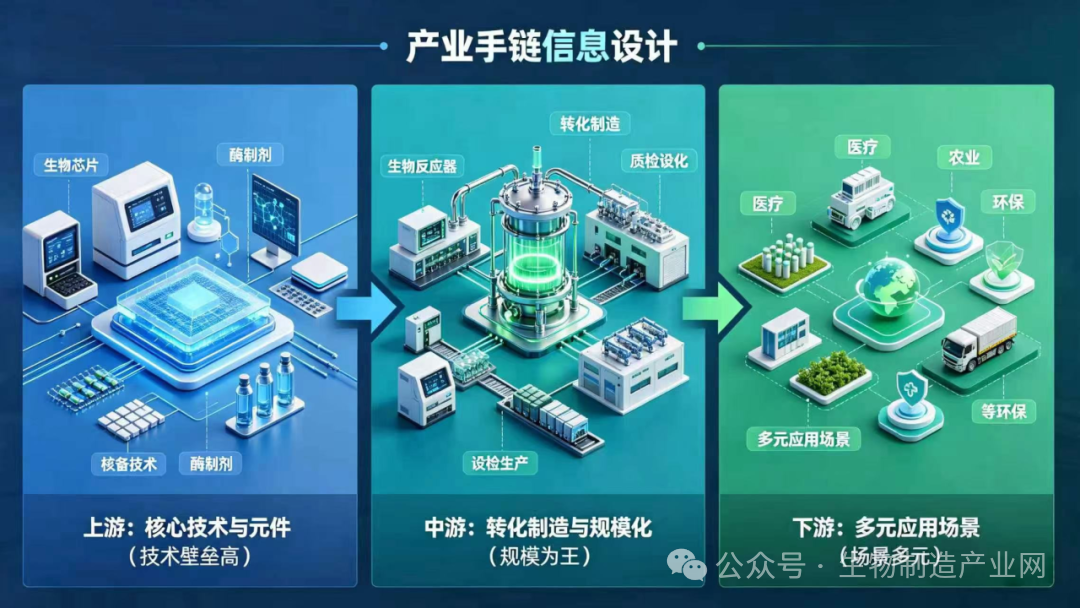
The biomanufacturing industrial chain presents a pattern of "high technical barriers in the upstream, scale dominance in the midstream, and diverse scenarios in the downstream", with each link interlocking and mutually reinforcing.
🔬 Upstream: Core technologies and components (gross profit margin: 55% - 75%)
The "brain" of an industry determines its competitiveness and cost floor.
Underlying technologies: gene sequencing/synthesis, gene editing (CRISPR), AI biological design, bioinformatics.
Core components: chassis strain, high-end enzyme preparations, culture medium, chromatographic packing material.
Key equipment: bioreactors, fermenters, high-throughput screening devices, and separation and purification equipment.
⚙️ Midstream: Transformation Manufacturing and Scaling (Gross Margin: 20%-40%)
The core link in bringing laboratory technology to mass production is the key to cost control.
Core process: Strain improvement → Small-scale fermentation → Pilot-scale amplification → Large-scale production → Separation and purification → Quality control.
Core capabilities: Fermentation efficiency, yield rate, batch-to-batch stability, energy consumption control.
Representative products: polylactic acid (PLA), polyhydroxyalkanoates (PHA), bio-based nylon, fuel ethanol, and bio-jet fuel.
📦 Downstream: Diverse application scenarios (gross profit margin: 5% - 30%)
The value realization terminal, covering the core areas of the national economy, guides the upstream research and development direction.
Bio-based materials: degradable plastics, carbon fiber precursors, eco-friendly coatings, and textile fibers (as alternatives to petrochemical materials).
Biomedical: Recombinant proteins, vaccines, insulin, antibiotics (green pharmaceuticals).
Bioenergy: fuel ethanol, bio-jet fuel, biogas (as alternatives to fossil energy).
Biological agriculture: microbial fertilizers, biological pesticides, feed additives (green agriculture).
Daily consumer goods: amino acids, vitamins, cosmetic raw materials, alternative proteins (health consumption).
III. Development Status: Trillion-scale Formation, China Leading the World
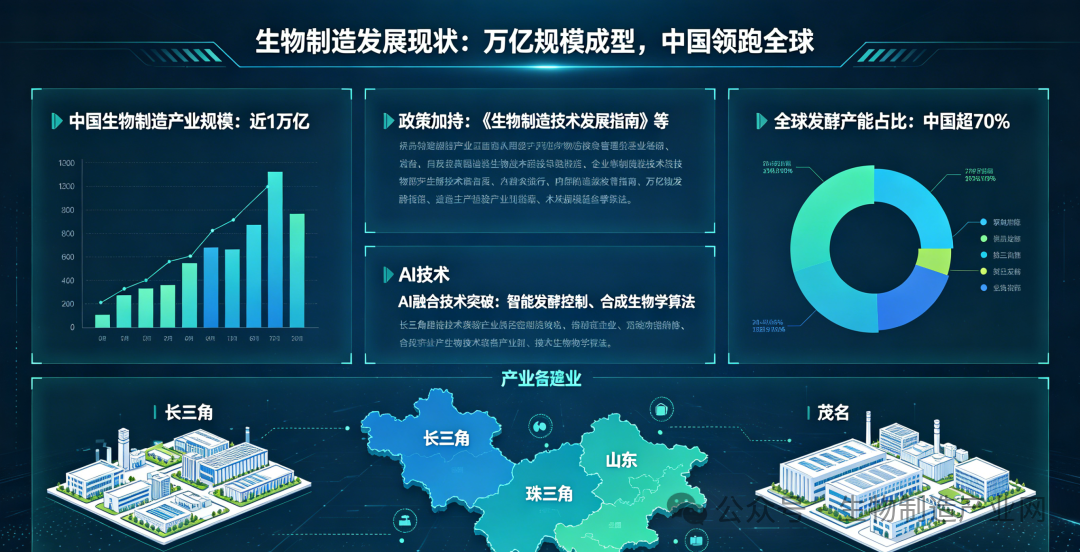
- Market size: The scale of China's biomanufacturing industry has reached nearly 1 trillion yuan, with its fermentation capacity accounting for over 70% of the global total; it is projected to reach 1.8 trillion yuan by 2030, accounting for nearly 25% of the global total, making China a global center for biomanufacturing.
Policy support: Included in the "14th Five-Year Plan" and the government work report. Multiple forms of financial support, such as national/provincial funds, special treasury bonds, and special bonds, are given to promote clusterization and high-end development.
- Technological breakthrough: The deep integration of AI and biological manufacturing has significantly enhanced the efficiency of cell factory design by 10 times; the utilization technology of non-food raw materials (such as straw and CO₂) has matured, breaking the reliance on food resources.
Industrial Agglomeration: Clusters have taken shape in regions such as the Yangtze River Delta, the Pearl River Delta, and Shandong Province. Cities like Maoming, which are strong in the chemical industry, leverage their petrochemical foundation to establish bio-manufacturing (such as polylactic acid) and promote the coupled development of "petrochemical + biology".
Four major trends: Key directions for the next 3-5 years
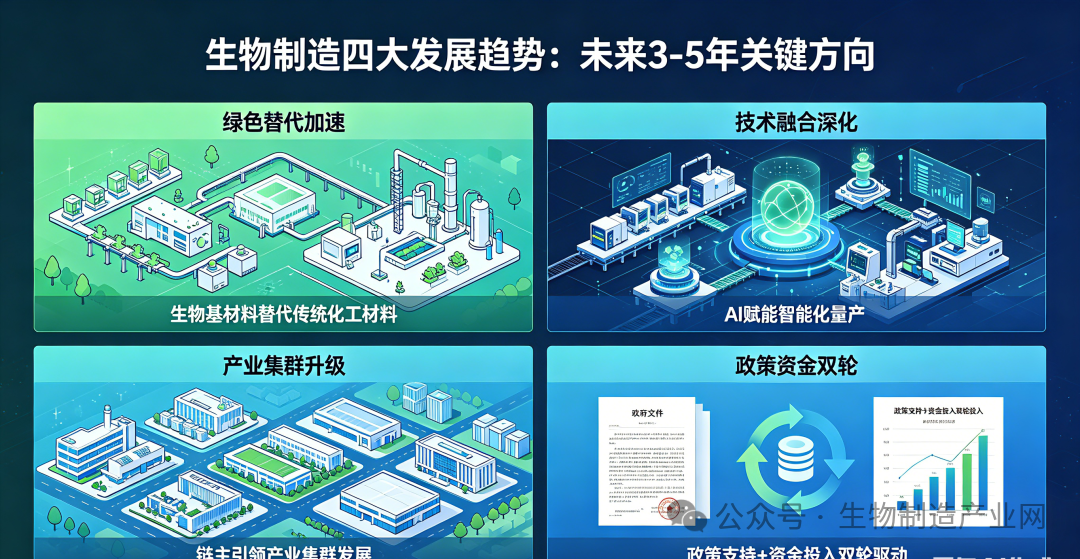
Green alternatives accelerating: From "optional" to "essential"
- Material substitution: By 2030, the proportion of bio-based materials will reach 30%, and degradable plastics and bio-based nylon will completely replace traditional petrochemical materials.
Energy substitution: Large-scale application of biojet fuel and fuel ethanol, contributing to carbon neutrality in the aviation and transportation sectors.
- Raw material revolution: Non-food-based materials (such as straw and forestry waste), and carbonization (CO₂ and methanol) have become the mainstream, reducing costs and ensuring food security.
2. Deepening of Technology Integration: AI Empowerment, Intelligent Mass Production
- AI + Synthetic Biology: AI designs bacterial strains and optimizes fermentation processes, addressing issues of batch instability and low efficiency, and shortening the research and development cycle by 50%.
- Popularization of biological manufacturing plants: An automated, high-throughput "design-build-test-learn" closed loop, enabling large-scale and low-cost production.
Domestic equipment manufacturing: High-end fermentation tanks and separation equipment have broken the import monopoly, reducing costs by 30% and providing a foundation for large-scale industrialization.
3. Upgrading of Industrial Clusters: Led by the Chain Leader, Full Chain Collaboration
"The 'Leading Enterprise + State-owned Capital + Fund' model: The leading enterprise takes the lead in operation, with state-owned capital and funds participating as shareholders. There is risk isolation and the project is implemented with a light asset approach."
Chemical and biological coupling: Petrochemical bases (such as Maoming) can leverage their existing facilities to develop bio-manufacturing, achieving mutual supply of raw materials, energy sharing, and cost reduction and efficiency improvement.
Circular economy takes shape: By-products (such as straw waste residue) are transformed into biofertilizers and feed, forming a "materials - fertilizers - agriculture" closed loop.
4. Dual-wheel approach of policy funds: top-level design + multi-dimensional financial support
-Policy benefits persist: The national/local plans have clearly designated biomanufacturing as a strategic industry, and the approval, land, and energy consumption quotas are given priority for this sector.
The capital matrix has been established: the national industrial fund (15%), the provincial strategic guidance fund (30%), ultra-long-term special government bonds (15%), special bonds (10%), and local state-owned capital (30%) are combined to provide support, thereby reducing the capital requirements for the project.
V. Conclusion: Biomanufacturing: Unlocking the New Era of Green Industry
Biological manufacturing is currently in a golden period of policy support, technological breakthroughs, and market explosion. It is the optimal solution for the transformation of traditional chemical industries and the cultivation of emerging industries. In the future, with the deep integration of AI technology, the large-scale utilization of non-food raw materials, and the coordinated upgrading of industrial clusters, biological manufacturing will completely reshape the industrial system that relies on "oil", becoming a trillion-dollar new industry sector and a new engine for green development.
For cities like Maoming that are strong in the chemical industry, developing bio-manufacturing (such as polylactic acid and bio-based materials) can not only extend the petrochemical industry chain and increase added value, but also respond to the "carbon neutrality" policy and cultivate new growth poles. It is a strategic choice for achieving "revitalization of traditional industries and expansion of emerging industries".