


Introduction
One-time disposable foam plastic tableware has been strictly prohibited from production and sales in China due to its difficulty in degradation and high pollution. The market urgently needs alternative materials that are environmentally friendly, safe, have processing capabilities, and are economically viable. Among various degradable polymers, polylactic acid (PLA), as a fatty acid polyester, is formed by polymerizing lactic acid obtained from renewable resources such as corn and sugar cane. After disposal, it can completely degrade into CO₂ and H₂O under industrial composting conditions, and it has the properties of biocompatibility, high strength, and processability, making it an ideal base material for green tableware.
The core requirements for green tableware in terms of polymer materials
Mechanical properties
The tableware must have sufficient load-bearing capacity. The tensile strength should be no less than 30 MPa to ensure that it does not deform or collapse after holding food. The elongation at break should be above 50% to guarantee that the food container will not undergo brittle rupture during transportation, stacking or dropping. The notch impact strength should be at least 20 kJ/m² to resist accidental impacts, such as during handling collisions or when the tableware is stacked under pressure.
Heat resistance performance
The heat distortion temperature (HDT, 0.45 MPa) should be above 80℃. To prevent the tableware from softening when in contact with hot food, causing deformation and leakage, and scalding the users. Therefore, the Vicat softening point or HDT of the material is one of the core indicators for evaluating whether green tableware can be used in actual dining scenarios.
Processing performance
The material should be compatible with the existing injection or blow molding equipment. The melt index (at 190℃, 2.16 kg) should be controlled within the range of 5 to 15 g/10 min, which ensures that the molten material can fully fill the complex mold cavity without being too thin and causing flash or cooling difficulties. The molding cycle should not exceed 40 seconds per mold. If the cycle is too long, the output of a single machine will decrease, the production cost will significantly increase, and it will be difficult to compete with traditional plastic tableware.
Environmental protection performance
The biodegradation rate must reach over 90% under the 180-day industrial composting conditions. After being discarded, the material can be decomposed by microorganisms into CO₂, water and biomass, without leaving microplastics or toxic products. At the same time, the material should meet the food contact safety standards to ensure that the migration of harmful substances is below the limit.
Economic cost
The raw material cost must be controlled within 12,000 yuan per ton. Disposable tableware is a low-value-added fast-moving consumer goods with extremely high price sensitivity. If the cost of the modified material is significantly higher than this level, even if the performance is superior, it will be difficult to promote in the market.
Environmental adaptability
The modified materials also need to meet the following requirements: after being immersed in water at room temperature for 24 hours, the strength retention rate should be no less than 80%, and there should be no leakage; when exposed to 100℃ edible oil for 30 minutes, they should not deform or leach out; when stored in a dry environment at room temperature, the shelf life should be at least 6 months, and their performance should not show significant deterioration.
Analysis of the adaptability of polylactic acid
High-strength support: The tensile strength of PLA (50-70 MPa) is much higher than that of starch and PBAT, ensuring that the food container does not deform when carrying food.
Good processing compatibility: PLA is a thermoplastic material that can be processed using mature techniques such as injection molding, blow molding, and thermoforming, and is compatible with existing plastic equipment.
Excellent environmental protection and safety: Completely biodegradable, without residues or toxins, in compliance with food contact material standards
Extensive modification possibilities: Through blending, filling, and chemical modification, it can specifically address issues such as brittleness and poor heat resistance.
The modification of PLA
The necessity of PLA modification
The elongation at break of pure PLA is only about 8%, while the requirement for food containers is no less than 50%. This means that pure PLA products will break under very small deformations and crack upon dropping; the heat deformation temperature is 58°C, but it requires at least 80°C, causing the food container to quickly soften and lose its support when holding hot soup; the notch impact strength is only 3 kJ/m². Even when converted according to the no-notch standard, it is far below the requirement of 20 kJ/m², unable to withstand minor collisions during daily use; the injection molding cycle is as long as 60 to 80 seconds, while industrial mass production requires no more than 40 seconds, resulting in an efficiency gap of over 50%. Without modification, the production cost remains high.
Modification methods
Blending modification
Utilizing the extremely high toughness of PBAT to compensate for the brittleness of PLA. By blending PBAT with PLA and adding compatibilizers, a stable "island structure" can be formed - PBAT is dispersed as micron or sub-micron particles in the continuous PLA phase. When subjected to impact, these PBAT particles become stress concentration points, dissipating the impact energy through mechanisms such as void formation and shear yield, thereby significantly increasing the fracture elongation and impact toughness of the blend.
Filler modification
To simultaneously enhance both heat resistance and strength, it is necessary to introduce rigid fillers with high heat resistance and high modulus. Nanocellulose is a natural nanomaterial extracted from plant fibers, with a crystallinity of up to 70% to 90% and an axial tensile modulus of over 150 GPa, and a thermal decomposition temperature exceeding 250℃. When nanocellulose is uniformly dispersed in the PLA matrix, its high specific surface area can form a large number of interface interactions with the matrix, forming a physical cross-linking network, which restricts the movement of PLA molecular chains at high temperatures, thereby significantly increasing the heat deformation temperature.
Plasticizing modification
Adding high-boiling-point and low-volatile small molecule plasticizers to the PLA matrix can dilute the PLA polymer chains, thereby exerting a lubricating effect. This reduces the interaction forces between the PLA molecular chains, enhances the fluidity of the molecular chains, lowers their crystallinity, and increases the proportion of the amorphous region. These changes result in a decrease in the Tg of PLA, an increase in the elongation at break, and a significant improvement in flexibility. The plasticization modification effectively enhances the plasticity and ductility of PLA materials, making them more suitable for manufacturing soft and elastic films and other products with elasticity.
Chemical modification
Chemical modification involves the co-polymerization and cross-linking of PLA with various monomers to adjust its molecular chain structure and surface properties, thereby improving the various properties of PLA, such as hydrophilicity, biodegradability, and resistance to brittleness. The chemical modification of PLA is mainly achieved through two methods: copolymerization and grafting.
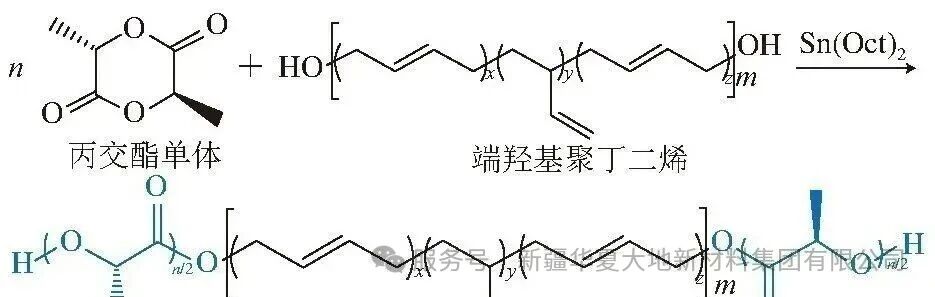
Chemical modification flow chart
Modification effect
Toughness: The elongation at breakage is greater than 150%, far exceeding the 50% requirement. The food container will not experience brittle fractures during transportation and usage.
Heat resistance: HDT > 85℃, meeting the actual requirements for holding 100℃ hot soup, addressing the core pain point of "hot food cannot be stored".
Processing efficiency: The molding cycle is ≤ 40 seconds, which is comparable to that of polypropylene. It is suitable for high-speed injection molding production and is economically feasible.
Environmental protection and safety: The biodegradation rate is over 90%, and there is no migration of heavy metals or harmful substances. It complies with national standards.
Cost: The cost of raw materials has dropped to around 12,000 yuan per ton, approaching that of traditional plastics. It now has the economic foundation for market promotion.
References
[1] Li Xiao, Guo Nanan, Wang Cheng, Kong Xinxin, Pan Daodong, Zhang Tao. Research Progress on the Application of Modified Polylactic Acid Materials in Meat Packaging [J]. Meat Science, 2025, 39(09): 69-77.
[2] Zhang Ailibimi, Lu Xuyan, Lu Xucheng. Research Progress on Preparation of Poly(lactic acid) and Mechanical Properties and Crystallinity Modification of Its Composite Materials [J]. Plastics Technology, 2025, 53(02): 187-192.
[3] Jamshidian M, Tehrany E A, Imran M, et al. Poly-lactic acid: production, applications, nanocomposites, and release studies. Comprehensive Reviews in Food Science and Food Safety, 2010, 9(5): 552-571.
[4] Al-Itry R, Lamnawar K, Maazouz A. Reactive extrusion of PLA, PBAT with a multi-functional epoxy-based chain extender: rheological, thermal and mechanical properties. European Polymer Journal, 2014, 58: 90-102.