


In the first half of 2026, China’s imports and exports of polylactic acid (PLA) exhibited a pattern of “increasing volume but declining prices.” Total imports reached 38,257 tons, surging 41.19% year-on-year, while exports grew modestly to 13,938 tons, rising only 9.58% year-on-year. The “import surge” coexists with an “export bottleneck,” and the trend of rising volumes alongside falling prices is likely to dominate the full-year performance.
Chinese PLA export data is referenced based on exports of polylactic acid in primary forms. While there is no separate, specific data for PLA, it is included within this category under tariff heading 39077000; hereinafter, PLA refers to polylactic acid.
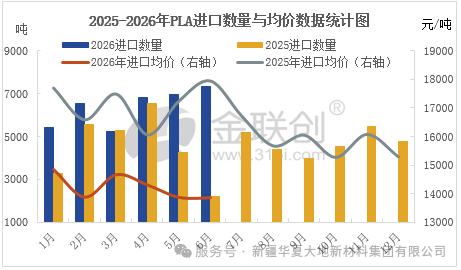
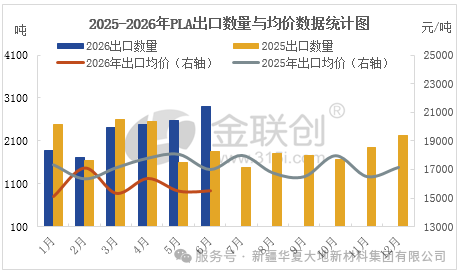
In the first half of 2026, China's PLA import and export showed a trend of "increased volume but declining prices." On the import side, driven by the ramp-up in production from Nature Works' new facility in Thailand, total imports reached 38,257 tons, a year-on-year increase of 41.19%. Imports in June alone hit a record high of 7,315 tons, surging 230.85% compared to the same month last year. The average import price dropped 17.04% year-on-year to 14,237 yuan per ton. On the export side, growth was moderate, with total exports amounting to 13,938 tons, up only 9.58% year-on-year, while the average export price declined 8.32% to 15,839 yuan per ton. Amid a surge in imports and constraints on exports, the pattern of rising volume coupled with falling prices may dominate the entire year.
1. Import volumes remained high in the first half, while prices experienced a significant decline
Source: General Administration of Customs of China, Jinlian Innovation
On the import side, import volumes showed strong growth in the first half of 2026, while import prices declined with fluctuations. In the first half of the year, China's total PLA imports reached 38,257 tons, up 35.04% quarter-on-quarter from the second half of 2025 and surged 41.19% year-on-year. In June alone, imports amounted to 7,315 tons, a 5.24% increase from the previous month and a remarkable 230.85% rise compared to the same period last year, setting a new temporary high for import volume. After the stabilization of Nature Works' new 75,000-ton facility in Thailand, a large influx of resources entered China's downstream PLA market, significantly enhancing the country's capacity to absorb imported supplies, particularly in the 3D printing sector. The average import price of PLA in China during the first half stood at 14,237 yuan per ton, down 17.04% year-on-year and 10.13% quarter-on-quarter from the second half of 2025. In June, the average import price was 13,850 yuan per ton, down 11 yuan per ton from the prior month and 22.78% lower than the same month last year. The expansion of global PLA production capacity in the first half of the year continued to exert pressure on supply, intensifying international price competition and shifting market pricing power toward buyers. The average price fell for three consecutive months in June, marking a sharp year-on-year decline and reaching a new low for the year, although signs of bottoming out remain evident.
2. Export growth remained moderate in the first half, with premiums narrowing
Data source: China General Administration of Customs, Jinlianchuang
In terms of exports, the export volume in the first half of 2026 showed a trend of initially weak and then strong growth, while the export price showed a trend of fluctuating decline. In the first half of 2026, the total domestic PLA export volume was 13,938 tons, increasing by 28.04% compared to the second half of 2025 and growing by 9.58% compared to the previous year. The export scale of Chinese PLA enterprises expanded moderately, but the overall growth rate was limited. The export volume in June was 2,891 tons, increasing by 12.58% compared to the previous month and increasing by 55.68% compared to the previous year. This indicates that the export volume in June was the highest for the year, but the export volume level remained within a small range. In the first half of the year, the average export price was 15,839 yuan/ton, decreasing by 7.64% compared to the second half of 2025 and decreasing by 8.32% compared to the previous year. The average export price in June was 15,533 yuan/ton, decreasing by 0.19% compared to the previous month and decreasing by 8.67% compared to the previous year. The international PLA market competition intensified, and domestic exporters faced price pressure from local production capacity in Southeast Asia and Europe. The global PLA prices generally declined, and the pricing of PLA exports was adjusted accordingly.
3. In the second half of the year, supply faced dual pressures, and imports and exports continued to show an increase in volume while prices dropped.
In the second half of 2026, as the overseas leading enterprises continue to expand their operations in Southeast Asia and the domestic PLA production capacity gradually shifts from "scale-driven" to "structure optimization", the competition in the imported market will become even more intense. In the short term, the international PLA suppliers still have strong growth resilience. The operating range of 6,000-7,500 tons per month is likely to become the new normal. The annual import volume is expected to exceed 80,000 tons, achieving a leapfrog growth compared to 2025. The deep decline in import prices is limited, approaching the cost line of international suppliers. However, the reversal momentum is insufficient. In the second half of the year, the coordinated promotion of domestic PLA export production capacity release and international market expansion in China will occur. However, there are certain differences between domestic materials and imported materials. The short-term volume breakthrough still requires time. It is expected to remain within the range of 2,000-3,200 tons per month. The export average price is expected to operate within the range of 15,000-16,500 yuan per ton.