
2026 marks the opening year of the 15th Five-Year Plan, and accelerating a comprehensive green transformation of economic and social development to build a beautiful China is one of the major strategic tasks outlined in the proposal for the 15th Five-Year Plan. The Party Central Committee and the State Council attach great importance to climate change response, having formulated and issued a series of policies—including guidelines, plans, measures, and strategies—on green and low-carbon transition, effectively promoting continuous improvement of energy-saving and carbon-reduction policy frameworks during the 15th Five-Year Plan period. How to fully and accurately grasp policy objectives and related requirements, and to plan and deploy green and low-carbon transition efforts, has become a critical strategic issue urgently requiring solutions from governments at all levels, industries, enterprises, financial institutions, and other stakeholders.
01 China's green and low-carbon policy system continues to improve.
According to incomplete statistics, since the first half of 2026 alone, relevant Chinese departments have密集ly issued 30 green and low-carbon policies, continuously refining the energy-saving and carbon-reduction policy framework for the 15th Five-Year Plan period. In terms of policy areas, these cover greenhouse gas inventory compilation, green consumption, green power certificates, industrial green microgrids, zero-carbon factory construction, the national carbon emissions trading market, electricity markets, development of green and low-carbon supply chains, hydrogen energy comprehensive application pilot programs, carbon emission accounting for public institutions, green design of industrial products, dual empowerment between artificial intelligence and energy, non-fossil fuel electricity consumption, renewable energy power integration, new energy system construction, energy-saving and carbon-reduction upgrades in key industries, direct green power connections, building a Beautiful China, and carbon peak initiatives during the 15th Five-Year Plan period—key areas in green and low-carbon development.
In terms of policy types, these measures include opinions, guidelines, plans, implementation plans, action plans, and evaluation methods. They encompass both incentive-based policies and guiding or regulatory measures, reflecting a rich and diverse range of policy tools.
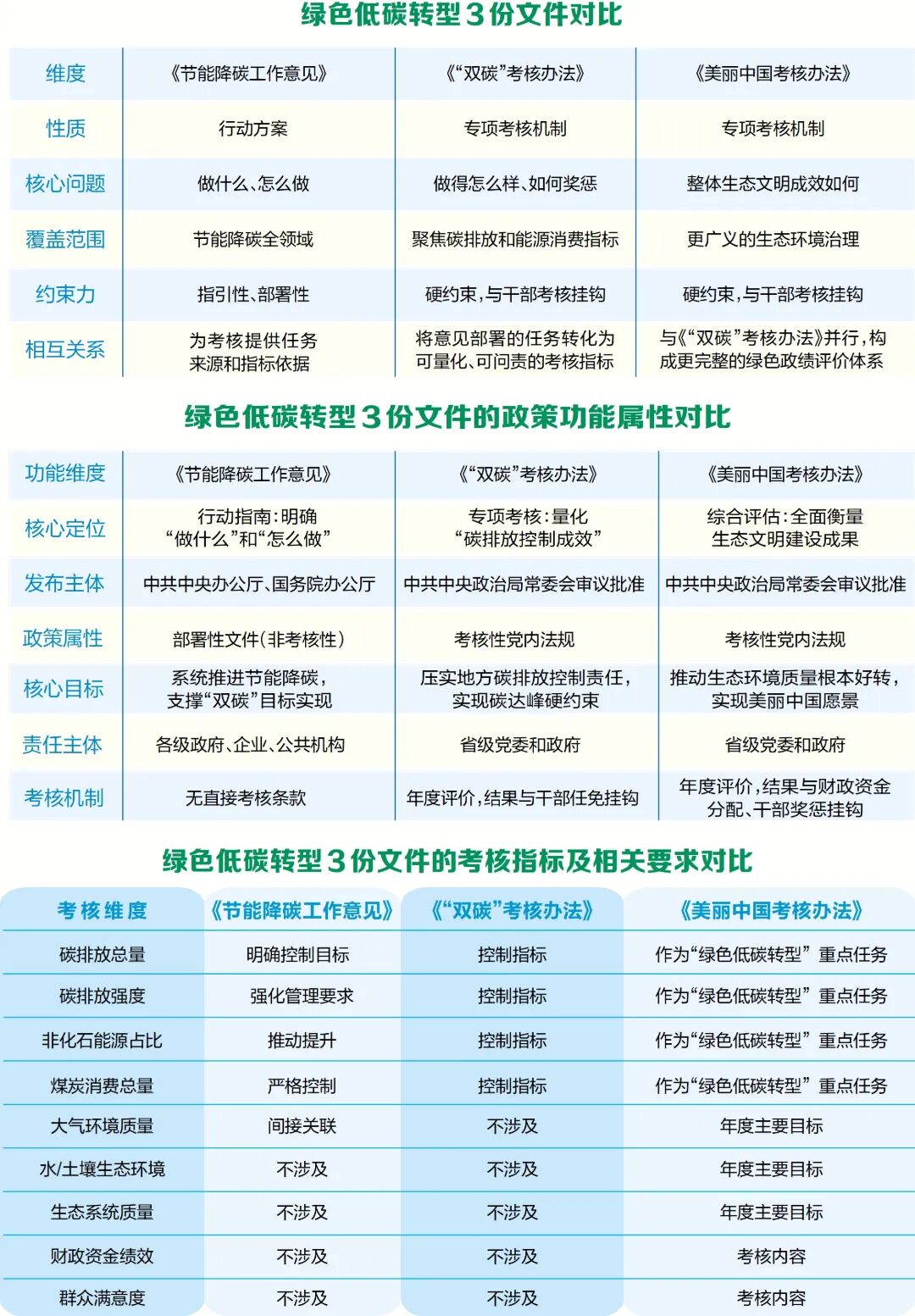
From a policy perspective, green and low-carbon development has shifted from top-level design to full implementation during the 15th Five-Year Plan period. In particular, strengthening evaluation mechanisms to establish rigid institutional constraints has become a key policy highlight and an essential tool for advancing policy execution. As early as April 2026, a series of green and low-carbon transition assessment policies were intensively released, including the "Opinions on Advancing Energy Conservation and Carbon Reduction at a Higher Level and with Greater Quality" (hereinafter referred to as the "Energy Conservation and Carbon Reduction Opinions"), the "Comprehensive Evaluation and Assessment Measures for Carbon Peak and Carbon Neutrality" (hereinafter referred to as the "Dual Carbon Assessment Measures"), and the "Assessment Measures for the Effectiveness of Beautiful China Construction" (hereinafter referred to as the "Beautiful China Assessment Measures"). These documents provide systematic arrangements for energy conservation and carbon reduction efforts during the 15th Five-Year Plan period and strengthen assessments related to dual carbon goals and Beautiful China initiatives, helping to promote the formation of a closed-loop policy mechanism.
02 The pathways and measures for green and low-carbon transition are becoming increasingly clear.
The 15th Five-Year Plan period marks a critical and decisive phase for China to achieve its carbon peak target. The country's fundamental conditions—energy structure dominated by coal, heavy industry bias in economic structure, and tight environmental constraints—remain unchanged. Fossil fuels and traditional industries still account for a significant share, energy conservation and carbon reduction remain challenging, and pressure on energy security continues to rise. The Outline of the 15th Five-Year Plan explicitly calls for comprehensive implementation of the dual-control system for total and intensity of carbon emissions, accelerating the institutional transformation from "dual control of energy consumption" to "dual control of carbon emissions," and establishing integrated evaluation mechanisms to promote a comprehensive green transition in socioeconomic development.
From task deployment to performance assessment, the policy framework for green and low-carbon transition is continuously improving. The "Opinions on Energy Conservation and Carbon Reduction," the "Dual Carbon Assessment Measures," and the "Beautiful China Assessment Measures" together form a core policy framework, covering action guidelines and evaluation benchmarks.
Released on April 11, the "Opinions on Energy Conservation and Carbon Reduction" serves as top-level design in this field, focusing on task deployment by clarifying overall requirements, key areas, and supporting measures for energy conservation and carbon reduction, answering the questions of "what to do" and "how to do it." Released on April 12, the "Dual Carbon Assessment Measures" functions as a supervisory mechanism emphasizing outcome evaluation, establishing a quantitative assessment system that primarily addresses "how well it is done" and "how accountability will be enforced." Released on April 25, the "Beautiful China Assessment Measures" is a macro-level comprehensive ecological assessment document, focusing on evaluating broader achievements in ecological civilization construction, including air and water quality, soil pollution prevention, ecological restoration, and biodiversity conservation, complementing the carbon peak and neutrality assessment system.
In terms of policy logic, the chain of "deployment–implementation–assessment" is growing clearer. Tasks outlined in the "Opinions on Energy Conservation and Carbon Reduction" serve as key sources for evaluation indicators in the assessment frameworks. For example, the emphasis on controlling coal and oil consumption in the Opinions directly corresponds to control targets in the "Dual Carbon Assessment Measures," providing hard constraints for local green transition efforts. The "Dual Carbon Assessment Measures" and the "Beautiful China Assessment Measures" both function as evaluation mechanisms: the former focuses on dual carbon control, while the latter emphasizes broader ecological civilization outcomes (such as environmental quality and ecological protection), creating a complementary relationship in local evaluations and promoting the implementation of a green, low-carbon, and sustainable performance-oriented governance model.
In terms of policy implementation, the simultaneous release of these three documents signals that green and low-carbon transition is moving beyond the stage of merely setting goals into the deeper phase of quantifiable assessments and strengthened accountability. The "Opinions on Energy Conservation and Carbon Reduction" sets the direction—defining tasks and specifying what needs to be done, how key sectors should reform, and how they should be managed. The "Dual Carbon Assessment Measures" tighten oversight—ensuring that core objectives from the Opinions, such as total and per-unit carbon emissions, coal and oil consumption, and the share of non-fossil energy, become binding evaluation criteria directly linked to officials' appointments and promotions. The "Beautiful China Assessment Measures" conducts a comprehensive evaluation, shifting focus from carbon alone to assessing overall green transformation performance across regions from a more holistic ecological perspective.
03 Analysis of the Core Content of Green and Low-Carbon Transition Policies
The "Opinions on Energy Conservation and Carbon Emission Reduction" serves as an action deployment document, focusing on pathways for energy conservation and carbon reduction. It outlines 18 specific measures targeting five key sectors: industry, construction, transportation, digital infrastructure, and public institutions. The "Dual Carbon Assessment Method" and the "Beautiful China Assessment Method" function as specialized evaluation mechanisms, with the former emphasizing the "dual carbon" goals and the latter focusing on ecological and environmental governance. The "Dual Carbon Assessment Method" establishes a "5+9" assessment indicator system and accountability mechanism centered on dual carbon targets, combining rigidity with flexibility. The "Beautiful China Assessment Method," under the framework of "carbon reduction, pollution control, green expansion, and growth," comprehensively evaluates local green governance performance across areas such as air, water, soil, ecological restoration, and biodiversity conservation, complementing the dual carbon assessment.
Opinions on Energy Conservation and Carbon Emission Reduction
Since the Eleventh Five-Year Plan period, energy intensity reductions have contributed over 70% to the decline in carbon emission intensity, and this contribution is expected to remain above 50% during the Fifteenth Five-Year Plan period. Energy conservation remains the most direct, economical, and effective pathway for carbon reduction. Guided by the principle of "dual carbon control," the "Opinions on Energy Conservation and Carbon Emission Reduction" clarifies key pathways for energy conservation and carbon reduction in priority sectors during the Fifteenth Five-Year Plan period. It sets out core requirements of "strictly controlling new additions, reducing existing capacity, and accelerating replacement," and proposes 18 concrete measures. These initiatives reflect both the systematic continuity and forward-looking innovation of policy design. The document emphasizes that all regions and departments must advance implementation under the centralized and unified leadership of the Party Central Committee, incorporating progress toward energy conservation and carbon reduction targets into comprehensive evaluations for carbon peak and carbon neutrality—directly leading to the second document.
Dual Carbon Assessment Method
The key strength of the "Dual Carbon Assessment Method" lies in establishing a clear assessment indicator system and accountability mechanism to address questions about "performance" and "how to incentivize or hold accountable."
First, it constructs a "5+9" assessment indicator system that balances constraint and flexibility. The five control indicators—total carbon emissions, carbon emission intensity reduction, total coal consumption, total oil consumption, and the share of non-fossil fuel consumption—are decisive factors in achieving carbon peak goals. The nine supporting indicators cover representative areas including energy conservation, industry, urban and rural development, transportation, public institutions, and carbon trading, all of which support the dual carbon objectives. Control indicators directly determine whether an assessment passes or fails, while supporting indicators break down macro-level goals into actionable and traceable domains, guiding regions and industries toward comprehensive green and low-carbon transformation. The indicator system reflects differentiation and scientific rigor. It avoids a one-size-fits-all approach by accounting for regional functional differences, establishes a dynamic monitoring and early warning system for critical data, and supplements missing statistics using national carbon market data and information from relevant departments, ensuring practical feasibility.
Second, it strengthens the application of evaluation results. Starting in 2026, China will evaluate provincial (autonomous region, municipality) Party committees and governments on their implementation of carbon peak and carbon neutrality goals under the principle of joint responsibility for Party and government. Evaluation outcomes are categorized as excellent, qualified, or unqualified. All control and supporting indicators meeting targets result in an "excellent" rating, with public commendation; partial failure without reaching the unqualified threshold leads to a "qualified" rating with official reminders; failure in one or more control indicators, or three or more supporting indicators, results in an "unqualified" rating, requiring a written report to the Party Central Committee and State Council within 30 working days. Results are submitted to the Organization Department and the Commission for Discipline Inspection of the CPC Central Committee, serving as crucial criteria for comprehensive evaluation, selection, appointment, and supervision of leadership teams and officials. The "Beautiful China Evaluation Method"
The "Beautiful China Evaluation Method" focuses on the outcomes of broad ecological civilization construction, covering areas such as air, water, soil, ecological protection and restoration, and biodiversity conservation, complementing the "dual carbon" evaluation framework. "Green and low-carbon transformation of development models" is a common cross-cutting area across the three documents. Article 5 of the "Beautiful China Evaluation Method" explicitly identifies this transformation as one of the key tasks, while Article 6 specifically requires that evaluations related to green and low-carbon development be aligned with the comprehensive assessment for carbon peak and carbon neutrality. Together, the three documents form an integrated policy framework of "deployment—implementation—evaluation," all emphasizing the integration of evaluation and application, as well as joint responsibility by Party and government, thereby achieving a closed-loop policy system.
04 Policy Synergy and Implementation Outlook for Green and Low-Carbon Transition
Currently, there is a lack of systematic and in-depth analysis regarding the logical relationship among the "Opinions on Energy Conservation and Carbon Reduction," the "Dual Carbon Assessment Measures," and the "Beautiful China Assessment Measures," particularly concerning policy hierarchy, coverage scope, and indicator alignment. The synergy mechanisms—such as overlapping and complementary indicators between the "Dual Carbon" and "Beautiful China" assessment frameworks, how assessment methods form a closed-loop with action-oriented policies, and how data sharing or coordination among responsible entities can be improved—are all critical factors influencing the effectiveness of green and low-carbon transition.
Policy Evolution Trend: From "Energy Consumption Dual Control" to "Dual Assessment on Carbon and Ecology." In terms of policy attributes, the shift from deployment documents to assessment-based intra-party regulations reflects a transformation of green and low-carbon policies from soft recommendations to hard constraints, marking a comprehensive upgrade in China's environmental governance capacity. The rapid release of these policies reveals a clear evolution trend—from past emphasis on "dual control of total and per capita energy consumption" to a new framework centered on dual assessments of carbon emissions and ecological performance. The five key control indicators proposed in the "Dual Carbon Assessment Measures" serve as core supports for the "green and low-carbon transformation of development patterns" task under the "Beautiful China Assessment Measures," while water, soil, ecological quality, and public satisfaction metrics in the latter provide valuable supplements to the former, creating a dual-wheel governance model driven by both carbon and ecological assessments.
Synergistic Policy Design and Interconnected Assessment Indicators. There exists a coordinated mechanism in the design of assessment indicators. Article 6 of the "Beautiful China Assessment Measures" explicitly states: "Assessments related to green and low-carbon transformation of development models shall be aligned with the integrated evaluation of carbon peak and carbon neutrality." This means that core indicators such as total carbon emissions, carbon intensity, share of non-fossil fuels, and coal consumption control are not only central to the "Dual Carbon Assessment Measures" but also serve as quantitative benchmarks for the green and low-carbon transformation goals in the "Beautiful China Assessment Measures," enabling data sharing, mutual recognition of indicators, and shared responsibility.
By strengthening accountability through assessment, the three documents together establish a closed-loop management system for green and low-carbon transition policies—covering planning, implementation, evaluation, and feedback. During the planning phase, the "Opinions on Energy Conservation and Carbon Reduction" outline low-carbon pathways and technological directions across industries such as manufacturing, construction, and transportation. In the implementation phase, local governments develop action plans based on these guidelines, carrying out energy efficiency upgrades, energy substitution, and project reviews. During the assessment phase, the "Dual Carbon Assessment Measures" conduct rigid evaluations on key carbon indicators, while the "Beautiful China Assessment Measures" perform comprehensive assessments on ecological quality, financial performance, and public perception. In the feedback phase, assessment results are jointly communicated by the Organization Department of the CPC Central Committee and other relevant agencies; regions deemed "non-compliant" face official interviews, and accountability measures are incorporated into the disciplinary inspection and supervision system. Assessment outcomes also serve as crucial criteria for cadre selection, appointment, and allocation of fiscal funds.
Author’s Affiliation: National Center for Climate Change Strategy and International Cooperation