

On July 14, the People's Daily published a report titled "Biodegradable Sandbags Help 'Use Sand to Combat Sand'" on page 11.
Standing on a dune in the Bai Tu Jing area of Minqin County, Wuwei City, Gansu Province—the site of the "Three-North" Project—Gao Feng, a senior forestry engineer with the Minqin County Forestry and Grassland Bureau, crouched down and patted the bulging "sand bags" beneath his feet. These cylindrical fabric containers, filled with yellow sand, are arranged in a 1.5-meter-by-1.5-meter grid across the desert floor, firmly trapping the shifting sands.
"In the past, we used wheat straw to combat desertification; now we can even 'use sand to control sand,'" Gao Feng explained, pointing at the sandbags. "These bags will naturally degrade in a few years, providing nutrients for the梭
Minqin County is surrounded by the Tengger and Badain Jaran deserts on its east, west, and north sides, with desertification covering over 90% of its area in the last century. To combat the encroaching sands, residents began exploring solutions as early as the 1950s. Under guidance from technical experts, locals learned to construct "straw squares" for sand fixation. However, "Minqin doesn't produce straw locally, so materials must be transported in. Straw easily deteriorates and breaks down; if the saxaul trees used for stabilizing the dunes haven't yet grown strong enough, we have to rebuild the squares whenever the wind blows," said Gao Feng.
In recent years, inspired by research on bio-based biodegradable materials, the Minqin County Forestry and Grassland Bureau has collaborated with scientific research institutions such as the Gansu Desert Control Institute to propose an idea: using biodegradable materials to create cylindrical bags, filling them directly with loose sand on dunes, and utilizing the sand itself to stabilize the dunes.
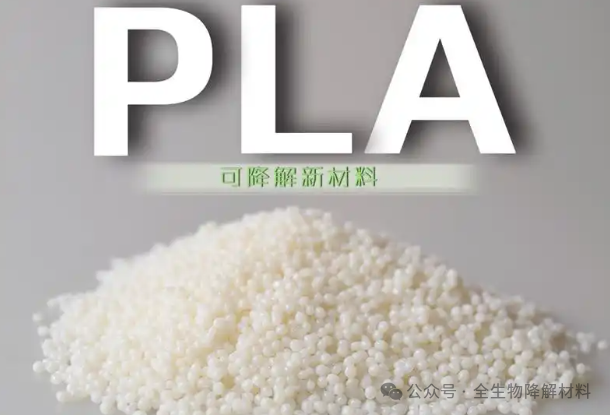
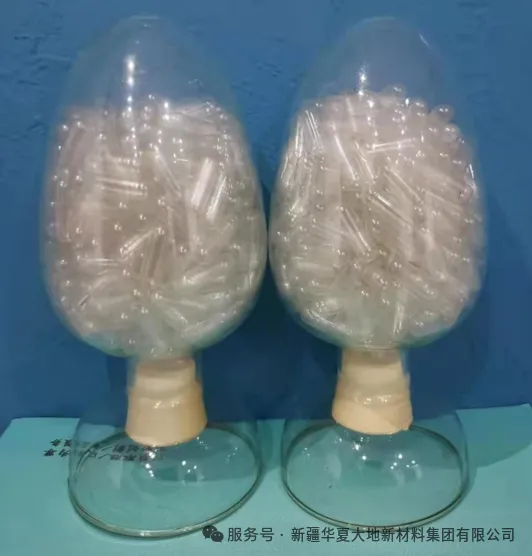
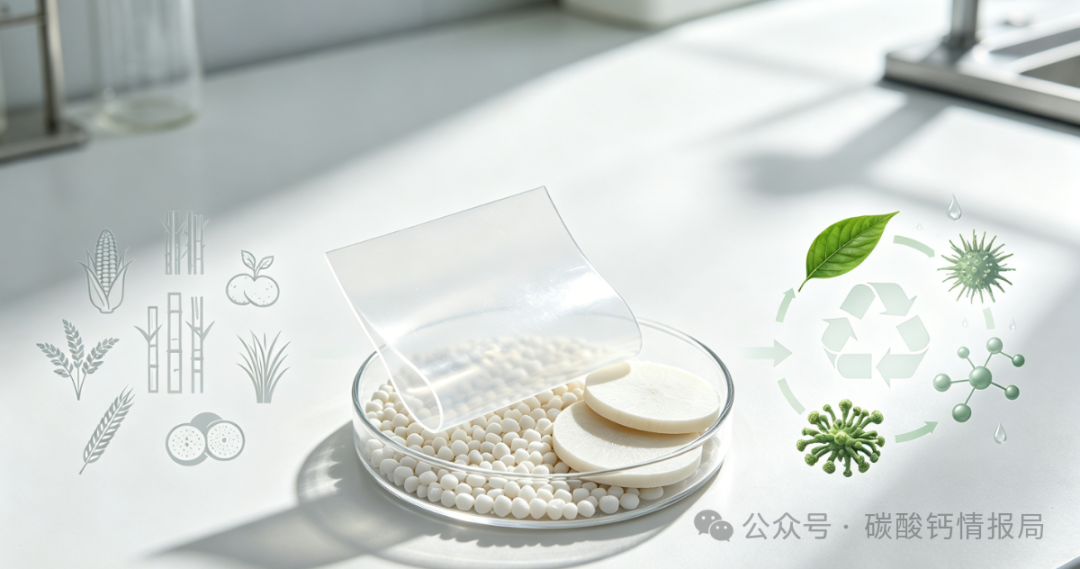
What materials should be used? The Minqin desert is inherently poor and fragile, so sand control materials must not introduce new pollution. The team started with biomass raw materials such as corn starch and cassava, fermented them using microorganisms to produce small-molecule lactic acid, then polymerized and melt-spun it into fibers. This bio-based polylactic acid fiber sandbag not only exhibits excellent UV resistance but also gradually hydrolyzes and undergoes enzymatic breakdown under microbial action, ultimately decomposing completely into water and carbon dioxide, achieving natural degradation.
"Using sand to combat sand is actually a very clever principle," Gao Feng explained, pointing to the boundary between the sandbags and the surrounding dunes. When the wind blows, surface sand collides with the sandbags, dissipating most of its force. The sand swirls within the grid-like spaces, becoming increasingly compacted and effectively "welding" the sandbags to the surface—a method consistent with traditional wisdom of "using wind to control wind, leveraging force to stabilize sand." The rough texture of the sandbag surfaces further reduces near-surface wind speed, helping maintain long-term stability of the sand surface.
Even more remarkable is the sandbag's ability to allow water penetration while retaining moisture. Rainwater or irrigation water seeps through the bag into the sand layer, where it evaporates slowly. "The method is relatively simple, highly effective in stabilizing sand and intercepting runoff, and offers strong resistance to wind erosion. Moreover, as the material degrades, it promotes vegetation growth within the sand barrier," said Gao Feng, who opened a partially degraded sandbag to reveal vegetation already half a foot tall inside.
Today, in Minqin County, the area of afforestation has exceeded 2.61 million mu, while over 3.25 million mu of natural desert vegetation have been protected through enclosure and restoration. A 380-kilometer-long green belt encircling the oasis forms a complete, closed-loop barrier, resulting in a dual reduction in both the area and severity of desertified and sandy lands across the county. Looking out, biodegradable sandbags arranged in square patterns dot the grass squares that serve as sand barriers, while plants such as Calligonum mongolicum, Haloxylon ammodendron, and Nitraria tangutorum have found their homes within these grids. Combined with photovoltaic panels, the "power generation on top, sand fixation beneath, and cultivation between" model has established an integrated protection system combining stabilization, obstruction, and sand transport, paving a new path for ecological priority and green development in arid and desert regions.
Further reading:
Biobased Biodegradable Polylactic Acid Sand Barrier Technology
The bio-based, biodegradable polylactic acid (PLA) sand barrier bag is woven from PLA fibers produced through a special manufacturing process. It features high resistance to ultraviolet radiation and excellent tear strength, with a service life exceeding ten years. After fulfilling its wind and sand control function, the material fully biodegrades into carbon dioxide and water, leaving no microplastic residue and preventing secondary pollution. The product allows air and water permeability, enabling the principle of "using sand to combat sand" and utilizing local materials. Its simple and efficient installation offers significant cost advantages throughout its lifecycle, making it an ideal alternative to traditional straw grids and non-degradable plastic sand barriers.
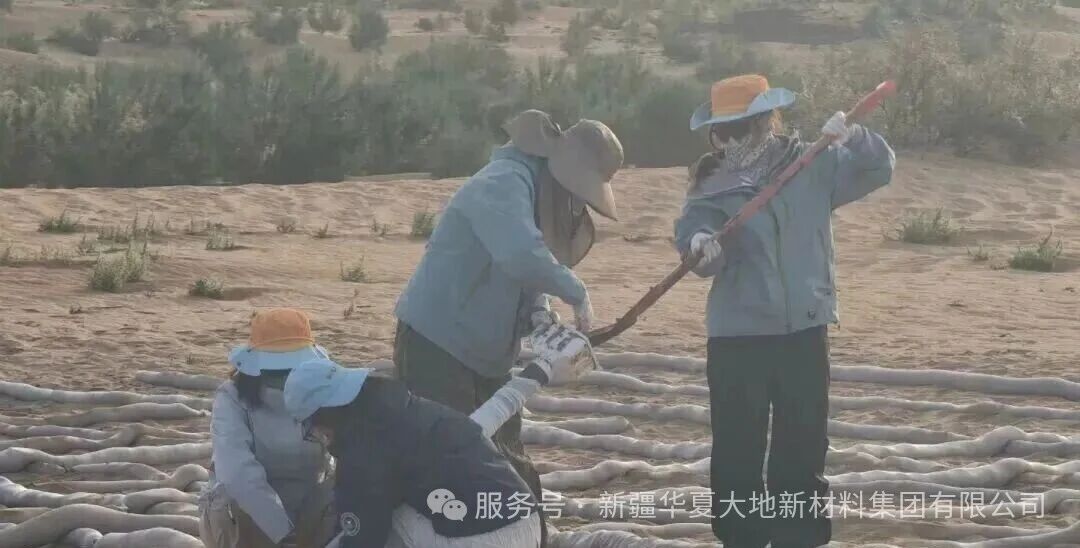 PLA sand barrier bag construction site
Applicable Area
Core requirements for domestic application: suitable for arid regions in northwestern China (Kubuqi, Badain Jaran, Tengger Deserts); applicable to mobile and semi-fixed dunes with sandy loam soil.
International adaptation core criteria: Adaptation to ecologically sensitive areas in Central Asia, Western Asia, North Africa, and Mongolia.
Technical Highlights
The material completely biodegrades into carbon dioxide and water, leaving no microplastics behind and avoiding secondary pollution. It is resistant to ultraviolet rays and has high tear resistance, with a windproof and sand-fixing effectiveness lasting for over ten years, meeting the long-term needs of engineering sand control. The bag structure facilitates water infiltration and air circulation, improving the micro-environment and aiding in the restoration of vegetation. No specialized skills are required. After simple training, two people can cooperate and operate together, and it can be laid manually or mechanically. The specifications are diverse: two types are available, one with a diameter of 8-9 cm (for regular sand control areas) and the other with a diameter of 17-18 cm (for wind-sand areas such as wind-swept mouths). They are suitable for 1-meter×1-meter or 2-meter square sand barriers.
Application Example
Xinjiang Photovoltaic Desert Control Project (from October 2025 to present): The project is located at the southern edge of the Taklamakan Desert. After the completion of the photovoltaic project, shifting sand invaded the area from the surrounding areas. The wind erosion depth around the base piers of the photovoltaic panels exceeded 1 meter, which affected the operational safety. By using polylactic acid sand barriers, the wind erosion was effectively reduced, ensuring the safety of the project.
Xinjiang Photovoltaic Desert Control Project (from November 2025 to present): Poly(lactic acid) sand barriers were laid around the photovoltaic project and beneath the panels, effectively preventing the invasion of surrounding sand dunes and reducing the impact of wind erosion on the foundation piles, ensuring the long-term safe operation of the project.
The wind erosion control project in Sifangdun Village, Minqin County, Gansu Province (from October 2025 to present): The area under the project suffered severe wind erosion. The previous two attempts using clay and grass mesh sand barriers both failed due to severe wind erosion. After applying polylactic acid sand barriers, stable concave surfaces were formed within the grids, and their shapes remained stable after the strong wind and sand in February 2026. It is planned to plant sand larches in November 2026.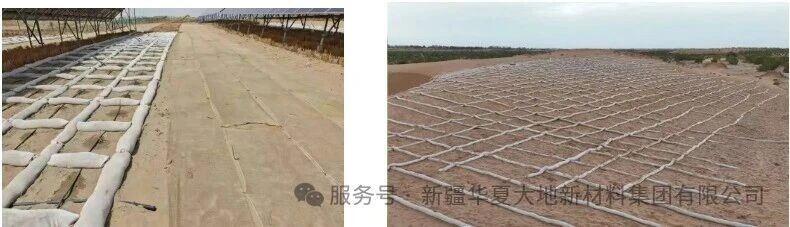
Photovoltaic desert control project and Minqin County, Gansu Province
The application site of the wind erosion control project in Sifang Dun area
People's Daily Office, China Desert Control and Sand Industry Society