
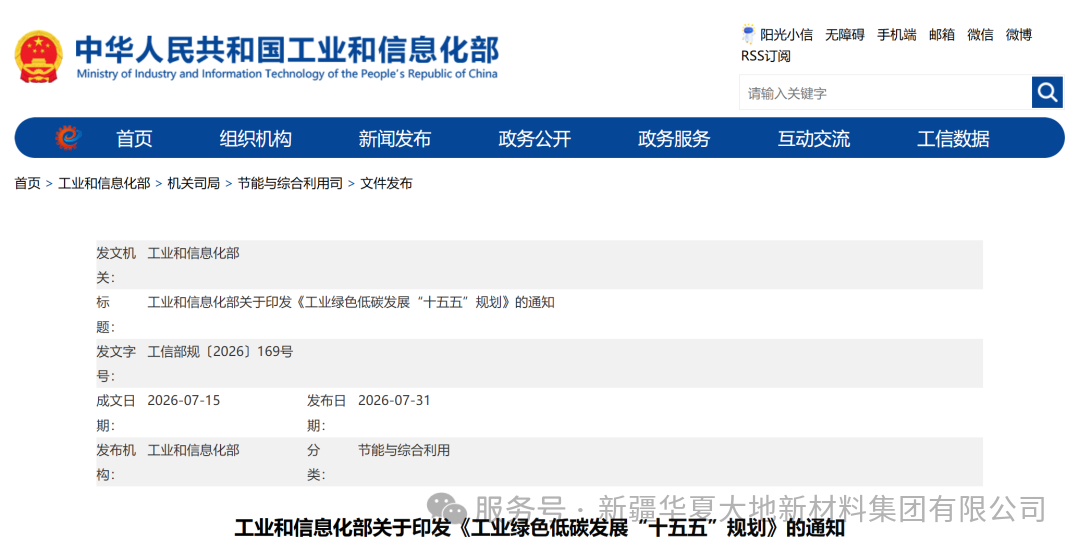
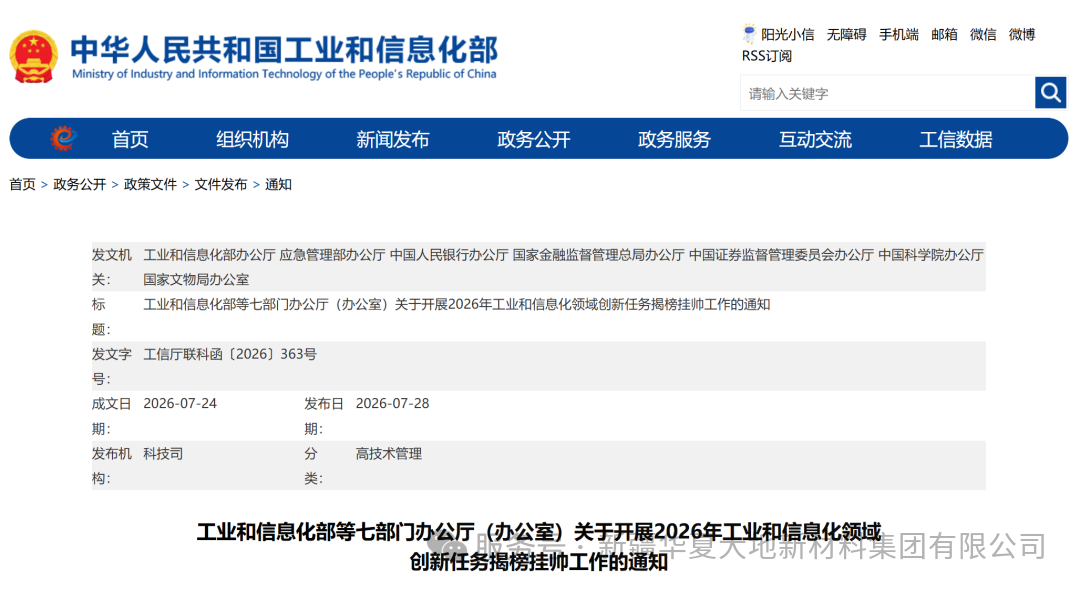
In just four days at the end of July, the Ministry of Industry and Information Technology issued two significant documents - on July 31, it released the "15th Five-Year Plan for Industrial Green and Low-Carbon Development", and on July 28, seven departments jointly issued the "Notice on Conducting the Task-Bidding Work for Innovation in the Industrial and Information Technology Field in 2026", specifically naming categories such as non-food bio-based fuel ethanol, biodiesel, bioaviation kerosene, high-performance degradable bio-based materials, poly(lactic acid) short fiber-specific oil agents, and bio-manufacturing high-performance separation and purification equipment.
By integrating the various "15-15" special plans that have been released recently, a clear list of bio-based product categories has emerged. Let's break them down one by one to see exactly what the policies have named.
01 Core document disassembly: One part for direction, one part for key tasks
Let's start with the "15th Five-Year Plan for Industrial Green and Low-Carbon Development" released on July 31. This document focuses on "cultivating and expanding green productive forces" and sets out seven major tasks.
In the chapter "Enhancing the Capacity for Creating Green Value in Industries", three sentences are clearly stated:
First, "accelerate the development and application of high-performance, biodegradable bio-based materials";
Second, "Develop non-food-based biofuels such as ethanol, biodiesel, and bioaviation kerosene for energy purposes."
Thirdly, "Increase the application of bio-manufacturing in fields such as papermaking, daily chemicals, and textiles."
These three sentences cover all three aspects of bio-based materials - materials, energy, and application scenarios.
On July 28th, the Ministry of Industry and Information Technology, the Ministry of Emergency Management, the People's Bank of China, the National Financial Regulatory Commission, the China Securities Regulatory Commission, the Chinese Academy of Sciences, and the National Cultural Heritage Administration jointly issued the "Notice on Conducting the 2026 Innovation Task Bidding and Commanding Work in the Field of Industry and Information Technology". This notice is structured around 6 directions and covers 24 topics. Content related to bio-based materials appears in two places:
The first direction is "Future Industries". A special topic, "High-performance Separation and Purification Equipment for Biomanufacturing", has been set up, jointly carried out by the Ministry of Industry and Information Technology and the Chinese Academy of Sciences. The key research tasks include 11 items such as high-performance biological macromolecular chromatography media and intelligent integrated efficient separation systems for bio-based products - in simple terms, this is to fill the gap in the "separation and purification" aspect of biomanufacturing, and it is a key equipment in the midstream of the industrial chain.
Recommended Reading: The Top Ten Challenges in China's Biomanufacturing Industry: After the Hype, the Real Problems Have Just Begun
The second direction is "Consumer Goods", where a special topic titled "Polymer Oil Additives Technology" has been set up. It includes a research task called "Special Oil Additives for Poly(lactic acid) Short Fibers", aiming to enhance the cohesion, hydrophilicity, smoothness, alkali resistance and antistatic properties of the fibers, thereby extending the storage period of poly(lactic acid) fibers and meeting the usage requirements in sectors such as spinning, non-woven fabric and filling. Expected goals: By 2028, the special oil additives for poly(lactic acid) short fibers will meet the production requirements of the fibers, with the fiber performance indicators conforming to relevant standards. The appearance of the oil additives will be uniform and transparent or milky white, with a solid content of no less than 40%, and the 5% emulsion usage concentration will remain stable without stratification for 72 hours at room temperature. The pH value of the 1% concentration will be within the range of 6.0 to 7.5, meeting the basic requirements. The oil additive products should be low-foaming or non-foaming, but it is not recommended to contain defoaming agent components, and they should not contain heavy metals or alkylphenol polyoxyethylene ethers (APEO). The specific resistance of the fibers (short fibers) should be less than 10^8 Ω·cm. The domestic market share is expected to increase by 5% to 6%, or be applied in 2 to 3 enterprises.
Two documents: one deals with "direction" - it tells you what to develop; the other focuses on "key breakthroughs" - it indicates where the technical bottlenecks lie. The policy signals are very clear.
02 Looking at all the "15-19" plans: Where else can we find the concept of bio-based?
The two documents above represent "points", while the other "15-19" plans represent "areas". Let's examine them one by one:
The "15-19 Carbon Peak Action Plan" of the State Council
Released on July 9th, 2026
In the chapter "Continuously Optimizing the Consumption Structure of Oil and Gas", it is clearly stated that "actively promote the application of green fuels such as green hydrogen ammonia alcohol, biodiesel, and sustainable aviation fuel"; in the transportation sector, it is proposed to "develop electric, liquefied natural gas, biodiesel, and green methanol-powered ships". This means that biodiesel is not only an industrial raw material but is also positioned as a transportation alternative fuel.
The "11th Five-Year Plan" for the Development of Renewable Energy issued by the National Development and Reform Commission and the National Energy Administration
Released on July 6th, 2026
The third section of Chapter 4 specifically addresses "steady development of non-food-based bio-liquid fuels", naming "biodiesel, non-food-based ethanol, and bioaviation kerosene", and requiring "to improve raw material supply and industrial standard systems, and promote their substitution applications in the transportation sector". This aligns closely with the category terms specified by the Ministry of Industry and Information Technology, indicating that it is a unified deployment at the national level.
The "11th Five-Year Plan for Circular Economy Development" of the National Development and Reform Commission
Released on July 3rd, 2026
When it comes to promoting "replacing plastic with bamboo" and advancing the comprehensive utilization of straw - these are all aspects of the raw material end of non-food bio-based materials.
The "15-16 Plan for the Development of the Postal Industry" issued by the State Post Bureau and three other departments
Released on July 29, 2026
By 2030, it is clearly stated that "the use rate of green packaging by express delivery enterprises will reach 80%". One of the core alternatives for green packaging is biobased degradable materials, which represents a huge downstream demand scenario.
The "Action Plan for Optimizing and Upgrading the Textile Industry Led by Standards (2026 - 2028)" jointly issued by the Ministry of Industry and Information Technology and other three departments was released on March 31, 2026.
Clearly state "accelerate the formulation of standards for green products such as biobased, degradable fiber materials and sustainable textiles", specifically naming categories like "biobased nylon 56". Leading with standards means that these categories are about to enter the "entry" stage for large-scale application.
When these provisions are combined, the list of specific product categories identified by the policy is already very clear: in the energy sector - non-food-based ethanol, biodiesel, and bioaviation kerosene; in the materials sector - high-performance biodegradable bio-based materials, polylactic acid (PLA), and bio-based nylon 56; in the application sector - papermaking, daily chemical products, textiles, express packaging, and ship propulsion. This is not a general "encouragement for development", but an industry roadmap that is precise down to specific categories and specific application scenarios.
03 From "Special Initiation" to "Systematic Deployment": The Three-Year Policy Upgrade Path
Finally, I would like to review the policy upgrade path since 2023 and see where we are at this stage.
In fact, over the past two decades, our country has been advocating the development of biomanufacturing. However, it has remained at the "advocacy" stage, without any specific plans, no quantified targets, and no category list. The real changes began in 2023.
In January 2023, six departments jointly released the "Three-Year Action Plan for Accelerating the Innovation and Development of Non-Cereal Bio-based Materials", which was the first specialized action plan specifically targeting non-cereal bio-based materials. For the first time, it set quantitative targets - the scale of lactic acid production lines should reach 100,000 tons, and valerolactam and polyhydroxyalkanoates should reach 10,000 tons. In December of the same year, the National Development and Reform Commission's "Industrial Structure Adjustment Guidance Catalog (2024 Edition)" added 7 categories of bio-based and degradable products compared to the 2019 Edition. The changes during this period were: bio-based materials shifted from "general promotion" to "having plans, goals, and categories".
March 2024 marked a turning point - the government work report for the first time included "biomanufacturing", positioning it as an "additional growth engine". The significance of these four words lies in the fact that biomanufacturing is no longer just an industry task for the Ministry of Industry and Information Technology and the National Development and Reform Commission, but has become an industrial strategic deployment by the State Council for the entire country. In October of the same year, the Ministry of Industry and Information Technology initiated the first collection of representative products in biomanufacturing, clearly identifying 9 major fields, including bio-based chemicals, bio-based materials, and bioenergy. The change during this period was that bio-based products advanced from "departmental work" to "national positioning".
From 2025 to 2026, the policies will enter the stage of systematic deployment.
The changes are manifested at four levels:
In terms of categories, from "collecting products" to "precise naming" - categories such as non-grain fuel ethanol, biodiesel, bioaviation kerosene, and polylactic acid were each individually named.
In terms of the scenario, from "encouraging application" to "clearly implementing", specific industries such as paper manufacturing, daily chemical products, textiles, express packaging, and marine power have been designated one by one.
In terms of the mechanism, from "collecting and promoting" to "announcing challenges and conducting research" - the special project on developing high-performance separation and purification equipment for biological manufacturing was officially approved for funding.
In terms of hierarchy, from "departmental documents" to "national planning" - in March 2026, bio-based materials were first included in the national five-year planning outline, and in April 2026, the State-owned Assets Supervision and Administration Commission required central enterprises to prioritize the purchase of bio-based materials.
Over the course of three years, the bio-based industry has moved from being "advocated for 20 years" to "category designation, scenario implementation, key project initiation, and planning integration into the framework". The policy has already drawn out the roadmap. For industry practitioners, the next step is to see who can take the lead.