


In the height of summer, endless dunes stretch across the Bai Tu Jing "Three-North" Project operation area in Minqin County, Wuwei City, Gansu Province. Zhang Shihu, a senior engineer at Minqin County's Forestry and Grassland Bureau, carefully examines the growth of saplings within sandbag squares. Neatly arranged cylindrical biodegradable fabric tubes filled with local sand form square-shaped sand barriers measuring 1.5 meters on each side, firmly anchoring shifting dunes and establishing a solid ecological barrier against desertification.
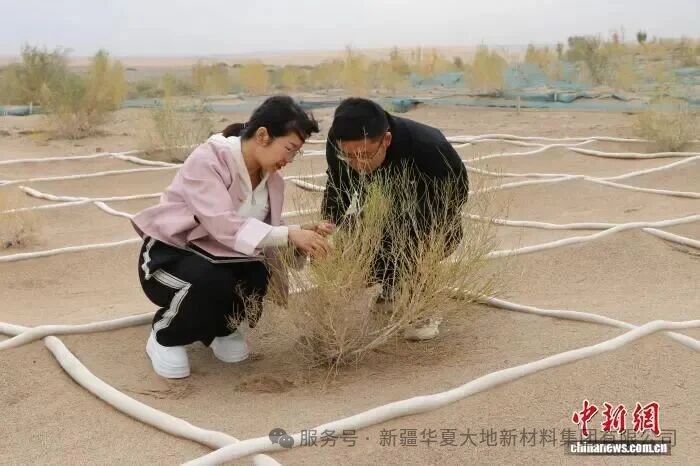 A photo shows staff carefully inspecting the growth of seedlings within biodegradable sandbag barriers in Minqin County, Wuwei City, Gansu Province. (File photo) Ma Aibin
According to Zhang Shihu, this new type of sand-fixing sandbag is a minor innovation within the "Three-North" Project's intensive campaign. Made from biomass materials such as corn starch and cassava, the sandbags are processed through microbial fermentation to extract small-molecule lactic acid, which is then polymerized and spun into bio-based polylactic acid fibers via condensation and melt spinning. The material exhibits excellent resistance to ultraviolet radiation and, once deployed, undergoes hydrolysis and enzymatic degradation under the action of desert microorganisms, ultimately breaking down completely into water and carbon dioxide—leaving no pollution or residue throughout the process. Moreover, the natural organic matter generated during degradation provides nutrients for young saxaul seedlings, improving soil quality while stabilizing sand dunes, thus achieving dual benefits of ecological restoration and enhanced soil fertility.
The new sandbag-based soil stabilization technology combines environmental friendliness and long-term stability, effectively addressing the shortcomings of traditional desert control methods and paving a new path for combating desertification.
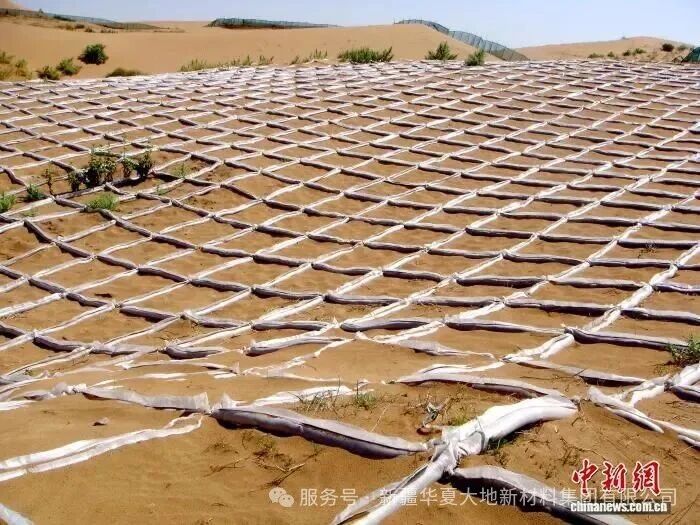
Neatly arranged biodegradable sandbag barriers firmly secure the shifting sand, preventing dune movement. (Photo by Ma Aibin)
As a key county for national desertification control, Minqin has continuously advanced efforts to combat desertification since the 1950s. With strong scientific support, it has long promoted the straw square grid method for sand fixation. However, this traditional approach has significant drawbacks: since straw is not locally produced, materials must be transported over long distances, resulting in high costs and extended delivery times. Additionally, straw has poor resistance to wind erosion and tends to degrade quickly. If young saxaul seedlings fail to establish roots promptly, the sand barriers become ineffective, allowing shifting sands to return and forcing repeated repairs and continuous rework, consuming substantial human and material resources.
To address the shortcomings of traditional sand fixation methods, Minqin County has collaborated with scientific research institutions such as the Gansu Desert Control Research Institute. Leveraging cutting-edge advancements in biodegradable materials, they have innovatively developed a new sandbag-based sand fixation technique. This new method fills sand locally, replacing the conventional practice of transporting materials over long distances, truly achieving "using sand to control sand and implementing solutions on-site," thus offering a novel approach to desertification management.
"When windblown sand passes through the sandbag grid, its kinetic energy is effectively dissipated. The sand accumulates and compacts within the squares, and the sandbags bond tightly with the sand surface, offering greater stability than traditional grass grids. This method follows natural principles and reflects Minqin's traditional wisdom of 'using wind to our advantage and harnessing forces to combat desertification,'" Zhang Shihu explained. He added that the rough surface of the sandbags also reduces surface wind speed, stabilizes shifting sands, and provides a stable environment for vegetation such as梭梭 (Suaeda) to grow, combining sand fixation with ecological restoration.
Minqin County, located in the core area of China's "Northern Sand Prevention Belt," serves as a front-line stronghold for combating desertification nationwide and is a vital ecological barrier for the Hexi Corridor. In recent years, Minqin has focused on comprehensive ecological restoration, establishing an overall layout of "expanding eastward, building westward, protecting southern areas, securing northern regions, and preserving the oasis in the center." By treating desert fringes, oasis interiors, sandy lands, watersheds, and mountain systems as management units, the county has effectively promoted various sand-fixation methods—such as sandbags, gravel, and nylon nets—tailored to local conditions. These approaches have overcome shortcomings of traditional methods, reduced sand-control costs, and enhanced the stability and ecological adaptability of sand barriers.
Based on engineering sand fixation, Minqin has combined engineering control with ecological restoration, scientifically configuring tree, shrub, and herbaceous vegetation according to the gradient distribution of water resources in sandy areas, thereby establishing a multi-layered vegetation protection system. At the same time, it adopts afforestation models featuring patchwork patterns and mixed planting of different age classes, simulating natural community structures to enable coexistence and mutual complementarity among seedlings at various growth stages, thus enhancing the stability of vegetation communities.
"New sand barriers such as biodegradable sandbags provide conditions for desert vegetation to firmly establish roots, naturally reproduce, and undergo orderly succession, gradually forming a self-repairing, low-maintenance near-natural ecosystem, promoting a shift in desert control from artificial sand fixation to ecological self-healing," said Jiang Liling, Deputy Director of the Minqin County Forestry and Grassland Bureau. She added that this "engineering sand fixation plus biological restoration" model has been promoted across the county's key demonstration zones under the Three-North Project.
Meanwhile, this governance model has translated into tangible ecological results. Today, Minqin County has preserved over 2.61 million mu of man-made forest plantations and protected more than 3.25 million mu of natural desert vegetation through enclosure and restoration. A 380-kilometer-long green belt around the oasis has been fully closed off. The area and severity of desertification and land degradation continue to decline simultaneously, and the region's ecological barrier function is steadily strengthening.