


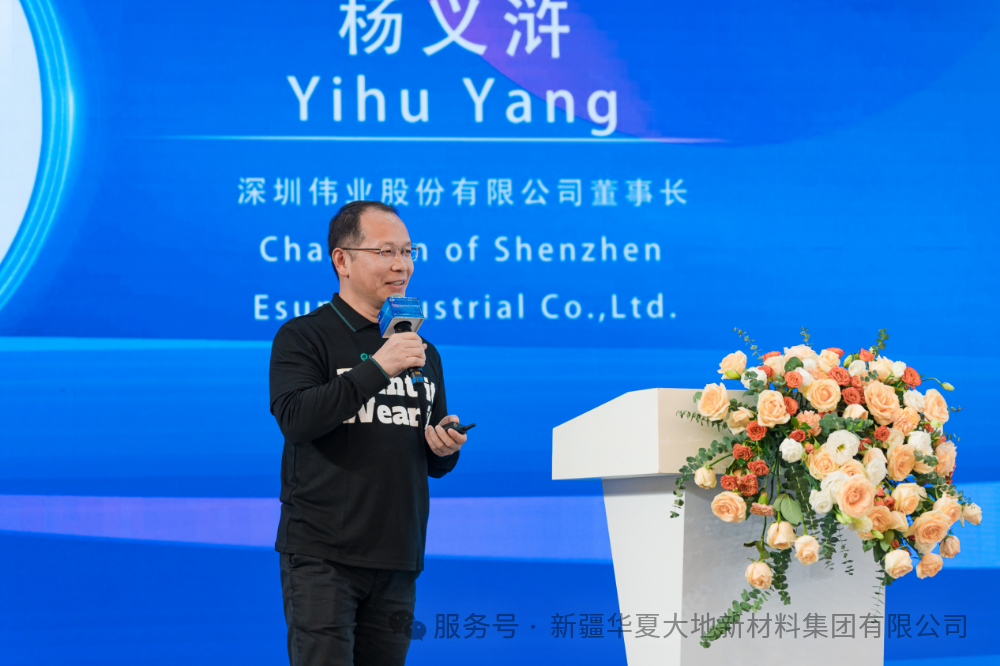
Recently, Textile & Apparel Weekly featured Guanghua Weiyeh / Yisheng New Materials’ Chairman Yang Yihu’s entrepreneurial journey as its central narrative, making a key argument: After 3D printing, fibers represent the next high-potential, rapidly emerging application area for polylactic acid (PLA).
1. Over Two Decades of Industry Forecasting and Strategic Path Selection
In the late 1990s, while working at the Hubei Provincial Department of Petrochemical Industry, Yang Yihu foresaw that, given China's coal and oil shortages, bio-based chemicals represented a longer-term path. In 2002, he founded Guanghua Weiye and acquired Wuhan University’s medical-grade PLA patent to enter the field.
In 2006, he first attempted PLA fiber production but encountered setbacks due to dyeing and breakage issues, and later withdrew from the market as it couldn't compete with petroleum-based packaging on price. That same year, he capitalized on the open-source FDM 3D printing wave by developing dimensionally stable, warp-resistant PLA filament. At a price of 200 yuan per kilogram, he secured orders immediately, becoming one of the world’s first companies to commercialize PLA 3D printing materials. By 2025, global consumption of PLA in 3D printing reached approximately 50,000 to 60,000 tons annually, with Guanghua shipping over 10,000 tons.
While 3D printing has become his cash flow pillar, the "seed of fiber" has always remained in his mind.

2. Why Bet on Polylactic Acid Fiber
Mature Conditions: In the early days, PLA's entry into textiles required overcoming three hurdles—modification technology, industrial chain synergy, and end-user acceptance. Over the past two decades, advancements in 3D printing have accumulated expertise in enhancing toughness, heat resistance, and dimensional stability (through molecular design, blending, nanocomposites, and crosslinking), which are now being applied to fiber development. This addresses key issues such as strength degradation, dyeing performance at 120°C+, drying shrinkage at 55°C+, softness, and achieves colorfastness ratings of 4–5.
Irreplaceable Material Properties: Naturally antibacterial and anti-mite, chemically similar to human lactic acid, pH-balanced for skin compatibility, with excellent drape and breathability, PLA is ideal for baby care, sensitive skin, underwear, and moisture-wicking sportswear. These health-oriented benefits are not replicable by polyester, making them essential rather than merely environmental selling points.
Process and Capacity: Yisheng New Materials has replaced chip spinning with melt spinning, eliminating secondary melting and reducing energy consumption by 30% (awarded the 2023 China Textile Industry Science & Technology First Prize). With a total designed capacity of 30,000 tons, the first phase of 15,000 tons is already operational, and full capacity will be achieved within the next two years.
Strategic Moves: In 2021, the company partnered with Hengtian Yangtze; by the end of 2023, it acquired 51.265% control and rebranded as Yisheng New Materials (Suzhou), completing its strategic layout across four sectors: 3D printing, eco-friendly fibers, biomedical applications, and single-use biodegradable materials.
Yang Yihu pointed out that the global brand and channel landscape in 3D printing is now consolidated, making it difficult for new entrants. The fiber sector, however, represents the next certain growth opportunity for the PLA industry—a vast super-market capable of supporting significantly larger volumes.
3. Scaling and Market-Driven Breakthrough Pathways
Collaborative Ecosystem: By partnering with associations to build platforms, we integrate yarns—dyeing and finishing—fabrics—brands, first testing small-scale production in three key segments: baby filling products, intimate apparel, and moisture-wicking sportswear, then scaling up. Simultaneously, we establish standards from raw materials to end consumers.
Closed-Loop Recycling for Cost Reduction: In 2013, a pilot plant for lactide recycling was launched in Xiaogan (approximately 3,000 tons), with plans to build a 30,000-ton coastal recycling facility. PLA is thermally pyrolyzed and reduced back into high-purity lactide, directly feeding melt-spinning lines—adopting a "recycle–regenerate–reuse" model instead of linear grain consumption. At scale, this will narrow the price gap with polyester, making green materials cost-competitive without premium pricing.
Fifteenth Five-Year Plan: First complete a 30,000-ton PLA melt-spun production line; aim for total capacity reaching 100,000 tons in medium-to-long term, while simultaneously expanding recycling facilities.
4. PLA Fiber Will Definitely Explode Within Three to Five Years
Market Timing: The introduction phase ended around 2020; we are now entering the growth stage. A breakout is certain within three to five years, with accelerated volume growth starting in 2027 and substantial domestic demand potential by 2030. This won't mean full replacement of polyester, but rather differentiated green penetration. In ten years, traditional chemical fiber plants may add PLA production lines. Further reading: Beyond Cotton Obsession—PLA Fabrics Featured in JD.com's Underwear Buying Guide
One-Sentence Summary: Yang Yihu built his foundation in PLA modification and global distribution through 3D printing. In 2023, by acquiring Hengtian Yangtze, he channeled technological advantages into PLA fiber, betting on a bio-based textile supermarket starting in 2027, powered by three pillars: melt spinning, chemical recycling closed-loop, and industrial chain alliances.