

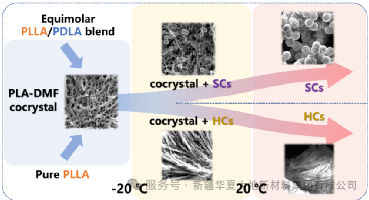
Polylactic acid (PLA) exhibits excellent biocompatibility and degradability, and thus has great potential in biomedical applications such as tissue engineering and drug delivery. However, due to the complex interactions between the phase separation and crystallization processes, achieving precise control over the pore structure remains a challenge. Recently, the team led by Professor Wu Hao and Zhang Jianming from Qingdao University of Science and Technology has achieved precise customization of the multi-form of PLA porous materials from three-dimensional nanofiber networks to monodisperse microspheres through thermal-induced phase separation technology, and has revealed the crystallization competition mechanism of the PLA/DMF system under temperature control. The study found that at -20 °C, PLA and DMF can form ε crystal type composite crystals, and after solvent removal, a nanofiber structure can be obtained; while at 30 °C, the equimolar PLA/LDLA copolymer mixture system spontaneously forms uniformly sized microspheres through a stereocomplex crystallization path. This work not only enables the design of the material morphology on demand, but also endows PLA porous materials with differentiated properties. The microspheres rich in stereocomplex crystals exhibit higher thermal stability and stronger enzymatic resistance. This research provides new insights into the interaction between crystallization and phase separation in the polymorphic PLA system, and the proposed strategy of designing PLA porous materials by regulating temperature and components has guiding significance for the research on tissue engineering scaffolds and drug delivery carriers.
This research was titled "Competitive Crystallization Mechanisms in Enantiomeric PLA/DMF Systems: Toward Tailored Porous Morphologies" and was published in the authoritative journal Crystal Growth & Design in the field of crystallography (DOI: 10.1021/acs.cgd.5c01670). Li Linbei and Zhang Xinqi, master's degree students from the School of Polymer Science and Engineering of Qingdao University of Science and Technology, were the co-first authors of the paper. Associate Professor Wu Hao was the corresponding author. Qingdao University of Science and Technology was the first completing unit. The paper link is https://pubs.acs.org/doi/full/10.1021/acs.cgd.5c01670. This research was supported by the National Natural Science Foundation of China and the Natural Science Foundation of Shandong Province.